Key Takeaways

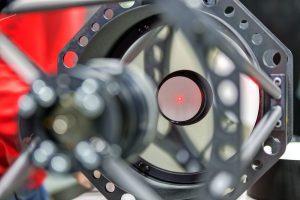
This technical note presents the design, implementation, and validation of a high-performance Ritchey–Chrétien (RC) telescope system optimized for deep space observation and spaceborne applications. The system achieves high imaging fidelity through precise optical design, controlled wavefront error, and structurally stable, lightweight construction.

Key system parameters include:

  • Effective focal length: 8840.56 mm
  • Aperture ratio: f/34
  • Field of view: 0.12°
  • Full-field RMS wavefront error: ≤ 0.035λ @ 632.8 nm

The system is designed to meet the requirements of aerospace optical payloads, ground-based observatories, and precision space monitoring applications.

1. System Architecture Overview

The optical system adopts a Ritchey–Chrétien (RC) reflective configuration, selected for its:

  • Elimination of primary coma and spherical aberration
  • High off-axis imaging performance
  • Achromatic behavior across broadband observation

The RC configuration is particularly suited for compact, long focal length systems requiring high angular resolution.

Key Optical Parameters

Parameter

Value

Effective focal length (f)

8840.56 mm

Design focal length

8840 mm

Back focal length (BFL)

1056.14 mm

Aperture ratio (f/#)

34

Field of view (FOV)

0.12°

Wavelength

632.8 nm

RMS wavefront error

≤ 0.035λ

RC Telescope System Designed by Avantier

2. Optical Design and Performance

2.1 Optical Configuration

The system employs a two-mirror RC design consisting of:

  • Hyperbolic primary mirror
  • Hyperbolic secondary mirror

This configuration enables diffraction-limited or near-diffraction-limited performance under controlled manufacturing tolerances.

2.2 Wavefront Quality

Wavefront performance is the primary indicator of imaging quality. The system achieves:

This corresponds to high Strehl ratio performance (typically ( S > 0.8 )), indicating near-diffraction-limited imaging.

2.3 Aperture Ratio and Light Control

The aperture ratio is defined as:

Where:

  • ( f ) = focal length
  • ( D ) = entrance pupil diameter

At f/34, the system prioritizes:

  • Suppression of stray light
  • Increased depth of focus
  • High-precision imaging stability
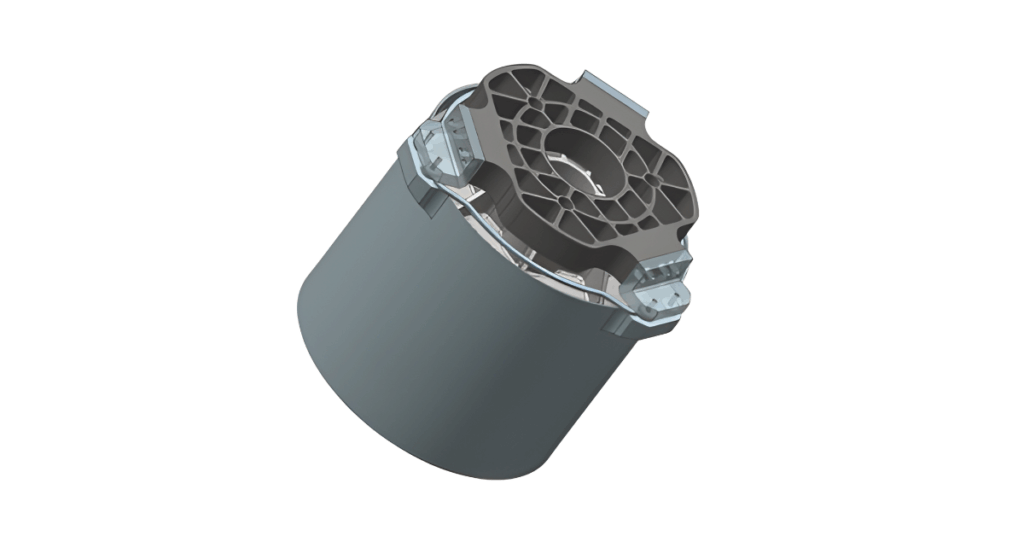
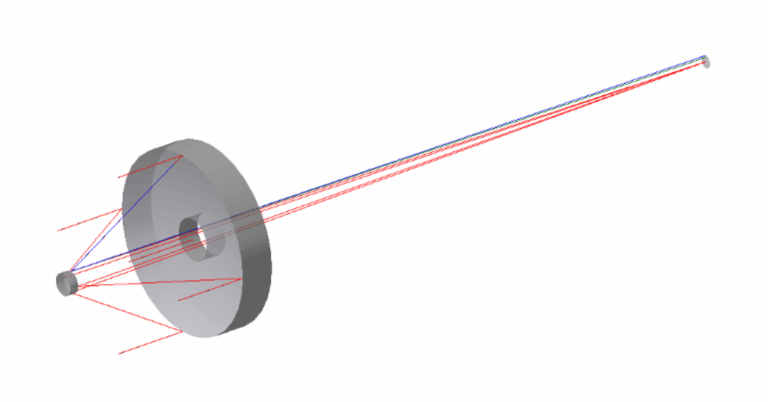
Structural Simulation of RC Telescope

2.4 Field of View Considerations

The field of view (0.12°) is optimized for:
  • Narrow-field, high-resolution observation
  • Targeted deep space imaging
This design reflects a trade-off favoring angular resolution over wide-field coverage.

3. Structural Design and Materials

3.1 Mechanical Architecture

The system is designed for structural stability under environmental and operational loads. Key design principles include:
  • Compact form factor: 293 × 290 × 274 mm
  • Modular integration of optical and mechanical subsystems
  • Alignment stability under thermal and mechanical variation

3.2 Material Selection

Material choices are driven by thermal stability, stiffness, and mass constraints:

Component

Material

Rationale

Optical tube

Carbon fiber

Low CTE, high stiffness-to-weight

Primary/secondary mirrors

Microcrystalline glass

Optical stability, machinability

Backplate

Composite material

Structural rigidity, weight reduction

Structural elements

Aluminum alloy

Manufacturability, strength

This combination ensures minimal deformation and stable optical alignment across varying conditions.

4. Manufacturing and Assembly

4.1 Optical Fabrication

Primary and secondary mirrors are produced using:
  • Multi-stage precision grinding and polishing
  • Surface figure control at sub-wavelength scale
  • Surface roughness minimization for scattering reduction
Critical tolerances include:
  • Surface figure accuracy
  • Radius of curvature precision
  • Surface roughness consistency

4.2 Structural Machining

Mechanical components are manufactured using high-precision CNC processes to ensure:
  • Tight dimensional tolerances
  • Accurate interface alignment
  • Repeatability in assembly

4.3 Alignment and Integration

System integration includes:
  • Optical axis alignment (coaxiality control)
  • Focal plane positioning
  • Iterative optical performance verification
Alignment is validated through interferometric feedback and iterative adjustment.

5. System Validation and Testing

5.1 Focal Length Measurement

Focal length is determined using the rotation method:

f = H tan(α)

Where:

  • ( H ) = image height
  • ( α ) = rotation angle

5.2 Back Focal Length (BFL)

Measured as the distance from:

  • Final focal plane
  • To the primary mirror vertex

Using:

  • Optical interferometry
  • Precision mechanical measurement tools


5.3 Wavefront Error Measurement

Wavefront error is measured via interferometry at 632.8 nm:

This cnfirms compliance with design specifications.


5.4 Environmental and Structural Testing

Validation includes:

  • Structural stability under simulated environmental conditions
  • Mass verification using precision instrumentation
  • Mechanical integrity and assembly tolerance inspection
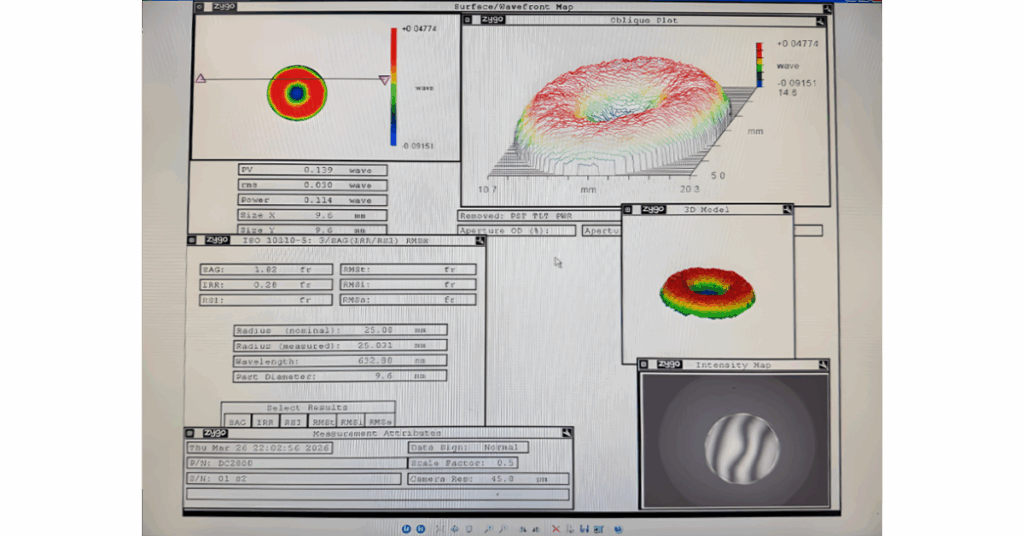
The measured transmission wavefront error is 0.03

6. System Capabilities and Applications

The system is designed for high-precision optical applications including:

Aerospace and Space Systems

  • Optical payloads for deep space missions
  • Satellite-based observation systems
  • Space situational awareness (SSA)

Astronomical Observation

  • High-resolution imaging of distant celestial objects
  • Integration into medium-aperture observatories

Tracking and Monitoring

  • Space debris tracking
  • Satellite trajectory monitoring

Scientific and Institutional Use

  • Advanced optical research
  • Educational observatories

7. Conclusion

This RC telescope system demonstrates a fully integrated approach to high-performance optical engineering, combining:
  • Precision optical design
  • Stable mechanical architecture
  • Controlled manufacturing processes
  • Verified system-level performance
The result is a compact, high-resolution optical system suitable for demanding aerospace and scientific applications. Lorem ipsum dolor sit amet, consectetur adipiscing elit. Ut elit tellus, luctus nec ullamcorper mattis, pulvinar dapibus leo.

GREAT ARTICLE!

Share this article to gain insights from your connections!