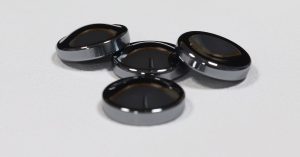
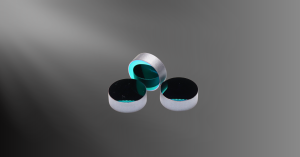
Chalcogenide materials are ideal for mid IR optics due to their wide transmission range from 0.5μm to 25μm, low refractive index temperature coefficient (dN/dT), low dispersion, and versatile glass compositions.
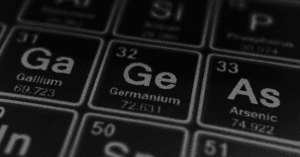
With excellent infrared transmission in both the 3-5µm and 8-12µm bands, these lenses excel in IR applications. Their high refractive index enables compact optical system designs, which is crucial for space-constrained environments. Avantier’s chalcogenide spherical and aspherical lenses leverage these advantages to deliver high-performance solutions for a wide range of applications. Moreover, compared to materials like germanium (Ge) and zinc selenide (ZnSe), chalcogenides offer higher production efficiency, reducing both costs and the reliance on scarce resources like Ge.
Chalcogenide Lenses
Key Benefits of Chalcogenide Glasses
Chalcogenide glass from Group 16 (oxygen O, sulfur S, selenium Se, tellurium Te, and polonium Po) offers exceptional properties for infrared optics. Its superior transmission, high refractive index, and nonlinearity make it a compelling alternative to traditional materials like germanium.
Wideband IR Transmission: Ideal for thermal imaging, sensing, and spectroscopy, covering 3-5µm and 8-12µm bands.
High Refractive Index: Enables compact, efficient optical systems, crucial in space-constrained applications.
High Nonlinearity: Perfect for nonlinear photonic devices and circuits.
Low Temperature Coefficient: Maintains performance across temperature variations, ideal for athermalized lenses.
Reliable Machinability: Easily shaped into custom spherical and aspheric lenses.
Applications
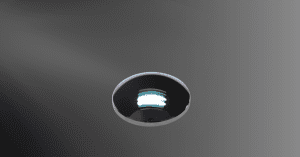
Avantier’s chalcogenide lenses find applications in infrared imaging, photonic integrated circuits, sensors, laser optics, and materials science. Offering cost-effective alternatives to germanium, these lenses provide high precision and quality. Additionally, chalcogenide windows excel in memory devices, optical fibers, and thermal systems due to their unique optical and electrical properties.
Sample Specifications for Chalcogenide Lenses
Size (mm)
Surface Precision
Coating Film
D 26.5
R1:73.215,
R2:23.118
1/4λ
Ravg <5.0% @3-12um
D 31.5
R1:231.532
R2:231.532
1/4λ
Ravg <5.0% @3-12um
Wide wavelength range covering MWIR (3-5µm) and LWIR (8-12µm)
Customizable with various lens forms (spherical or aspheric)
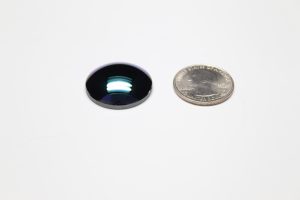
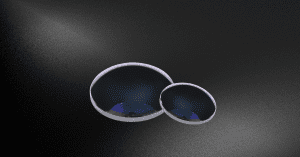
Chalcogenide Lens compared to a coin
Use Case: Chalcogenide Optics for a Germanium-Free F/1.0 LWIR Lens
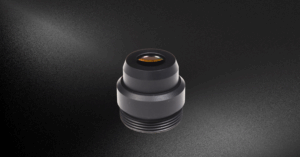
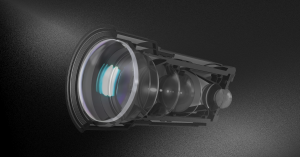
For a compact LWIR imaging system, a customer required a 13.5 mm F/1.0 lens compatible with a 640×512, 12 μm detector and an M18×0.5 mechanical interface. The lens assembly had to be completely germanium-free while maintaining high image quality across the 8–14 μm band and stable performance over a wide operating temperature range.
To meet these requirements, we selected alternative LWIR materials, including sulfur-based infrared glass, and applied molded aspheric elements to correct large-aperture spherical aberration and coma within a restricted mechanical envelope. The final design kept the full-field RMS spot size within the 12 μm detector pixel pitch, with distortion reduced to below 1%.
Because the selected infrared materials are more sensitive to edge chipping and process variation than germanium, precision molding and controlled opto-mechanical assembly were used to improve manufacturability and repeatability. The lens was also designed for DLC coating to enhance environmental resistance while maintaining high transmission in the LWIR band.
Full-temperature verification confirmed stable MTF performance from -40°C to +85°C without mechanical refocusing. This case demonstrates how chalcogenide and other germanium-free infrared materials can support compact, high-speed LWIR lens designs where large aperture, small form factor, and supply-chain risk reduction are critical.
Parameter
Value
Application
Compact LWIR thermal imaging
Detector
640×512, 12 μm
Focal Length
13.5 mm
F-number
F/1.0
Spectral Range
8–14 μm
Interface
M18×0.5
Lens Material Direction
Chalcogenide / germanium-free LWIR materials
Key Process
Molded aspheric optics
Coating
DLC-compatible
Temperature Range
-40°C to +85°C
Custom Solutions
Avantier offers high-performance,custom-designed chalcogenide lenses to meet specific research needs. Additionally, this series can be processed using conventional grinding and polishing techniques, single point diamond turning, or precision molding technology, making it suitable for your specific requirements. Our expertise ensures superior optical clarity, durability, and reliable performance.