

Introduction: The Invisible Backbone of Advanced Technology
In the world of advanced technology, some of the most critical components are also the least visible. Among them are ultra-precision optical mirrors—devices so accurate that their surface errors are measured in fractions of a nanometer.
These mirrors are essential to some of the most demanding applications in modern science and industry, including:
- Extreme Ultraviolet (EUV) lithography for semiconductor manufacturing
- High-energy laser systems
- Aerospace and deep space exploration
At the heart of these applications lies a remarkable requirement: surface precision at the sub-nanometer level.
What Does “Sub-Nanometer Precision” Really Mean?
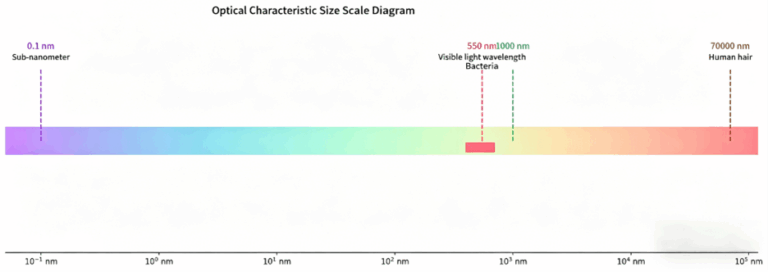
A nanometer (nm) is one-billionth of a meter. Sub-nanometer precision refers to surface deviations smaller than that—often down to 0.05–0.1 nm RMS, approaching atomic-scale accuracy. To put this into perspective:- These mirrors must maintain surface smoothness far below the wavelength of visible light
- Even the slightest deviation can significantly degrade performance in high-end optical systems
Where Are These Mirrors Used?
1. EUV Lithography (Semiconductor Manufacturing)
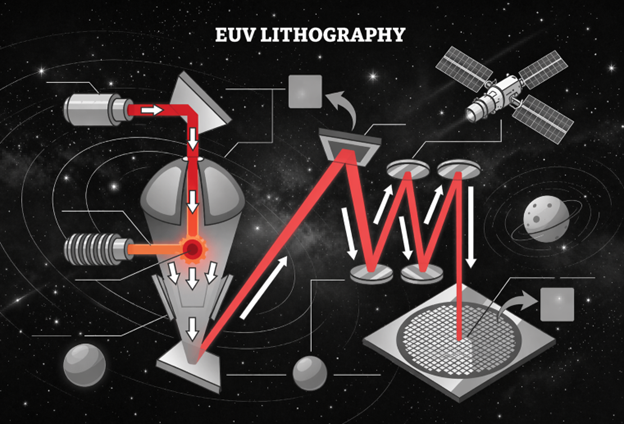
EUV lithography represents the cutting edge of semiconductor fabrication. Each system requires dozens of ultra-precision mirrors with specifications such as:- Surface accuracy of λ/50 to λ/100 (PV)
- RMS error below 0.15 nm
- Surface roughness below 0.1 nm
2. High-Energy Laser Systems
In high-energy laser applications, mirrors must handle extreme conditions while maintaining optical performance. Key requirements include:- Sub-nanometer surface precision
- Ultra-low scattering
- High laser damage resistance (>30 J/cm²)
3. Aerospace and Deep Space Exploration
Space-based optical systems impose additional constraints:- Large-aperture mirrors (Φ300–500 mm or more)
- Lightweight structures
- Low thermal expansion
- Long-term stability in orbit
A Highly Competitive and Specialized Industry
The global market for sub-nanometer precision mirrors is characterized by:- High technical barriers
- Oligopolistic competition
- Regional specialization
- Carl Zeiss AG
- Zygo Corporation
Avantier’s Position in the Global Landscape
Against this backdrop, Avantier has emerged as a top-tier manufacturer of sub-nanometer precision mirrors, competing directly with established global leaders. Its strengths lie in:- Proprietary core technologies
- Stable mass production capabilities
- Industry-leading product specifications
An Integrated Approach to Ultra-Precision Manufacturing
One of the defining features of Avantier’s strategy is its philosophy of: “In-house R&D + integrated innovation” This approach enables tight control over every stage of production, including:- Substrate material development
- Ultra-precision processing
- Optical coating
- Closed-loop inspection
From Materials to Final Performance: A Complete System
Advanced Materials as the Foundation
High-performance mirrors begin with carefully engineered substrate materials such as:- Fused silica
- Silicon carbide (SiC)
- Thermal stability
- Mechanical strength
- Machinability
Precision Manufacturing and Process Integration
To achieve sub-nanometer accuracy, manufacturing must go beyond conventional polishing techniques. Avantier has developed a comprehensive process chain that combines:- Ultra-precision grinding
- Advanced polishing technologies
- Final-stage corrective processes
Optical Coating and Stability
Coating plays a critical role in both performance and durability. Advanced multilayer dielectric coatings provide:- Extremely high reflectivity (up to 99.98%)
- Enhanced laser damage resistance
- Controlled internal stress to prevent deformation
Closed-Loop Inspection and Digital Optimization
Equally important is the ability to measure and control precision at every stage. Avantier employs:- Sub-nanometer in-situ detection systems
- Real-time monitoring and feedback
- Digital twin technology for process optimization
- Detection accuracy down to 0.03–0.08 nm (RMS)
- Reduced processing cycles
- Improved yield and consistency
Why This Technology Matters
Sub-nanometer precision mirrors are not just components—they are enablers of technological progress. They make possible:- The continued scaling of semiconductor devices
- Advances in high-energy physics and laser systems
- Exploration of deep space and the universe
Conclusion: Precision at the Edge of Physics
As industries push toward ever higher performance, the demand for ultra-precision optics continues to grow. Companies like Avantier are driving this progress by combining:- Advanced materials
- Innovative processing technologies
- Integrated manufacturing systems
Next Step
While this article provides an overview of the technology and its significance, the question remains:
How are such extraordinary levels of precision actually achieved in practice?
In the next article, we will explore the manufacturing processes behind sub-nanometer precision mirrors, including advanced polishing, ion beam techniques, and precision metrology.




GREAT ARTICLE!
Share this article to gain insights from your connections!