

Introduction: Engineering Optical Control for Quantum Systems
- Delivering high numerical aperture (NA) alongside long working distance (LWD) presents a classic optical design trade-off—one that becomes critical in quantum computing. Whether addressing neutral atoms in optical lattices or ions in cryogenic traps, the objective lens must provide diffraction-limited performance while maintaining vacuum-compatible clearance.
- This article moves beyond general theory to examine the manufacturing challenges of high-NA objectives. We explore how precision alignment and specialized coatings enable the sub-nanometer stability required for qubit manipulation and high-fidelity readout.
1. The Foundations of Quantum Computing
1.1 From Bit to Qubit: Computing Beyond Classical Limits
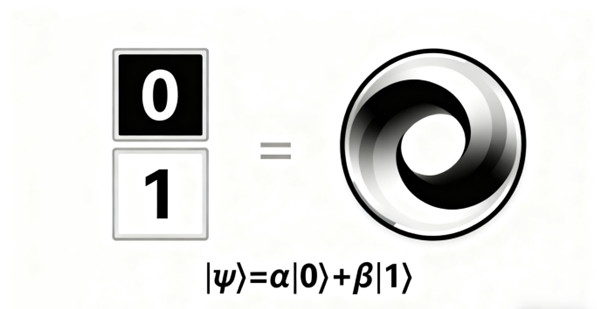
Traditional computers operate using bits, which are either 0 or 1. Quantum computers use qubits—quantum bits—that can exist in both states simultaneously due to superposition.- Superposition allows qubits to process multiple possibilities at once, leading to exponential increases in computing power.
- Entanglement links qubits so that changes in one instantly affect the other, even at a distance. This interdependence underpins advanced applications in simulation, cryptography, and optimization.
1.2 The Fragility of Qubits: Why Quantum Capture Matters
Qubits are extremely sensitive to their environment. Small vibrations, heat fluctuations, or stray electromagnetic fields can destroy their delicate quantum states—a phenomenon known as decoherence. To preserve stability, scientists use quantum trapping—isolating and controlling quantum particles with high precision. Optical systems, particularly microscope objectives, are central to this process, enabling direct observation and manipulation at the nanoscale.2. Quantum Capture in Practice: How Microscope Objectives Enable Control
2.1 Ion Traps: Laser-Controlled Ions in Motion
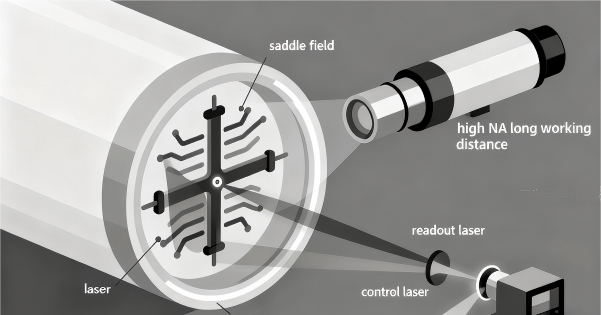
Ion traps use electric fields to hold single ions in place within a vacuum chamber. Lasers are then used to excite or read the ions’ quantum states.
High NA (high numerical aperture) objectives play two vital roles:
- Photon collection: The emitted ion fluorescence is extremely faint (only thousands of photons per second). High-NA lenses act as light collectors, capturing signals efficiently for accurate measurement.
- Long working distance: The objective must maintain clearance from electrodes and vacuum hardware. Objectives with working distances of 10 mm or more prevent interference while maintaining optical focus.
2.2 Photonic Quantum Computing: Stopping Racing Photons
In photonic quantum systems, light itself carries quantum information. Photons move at the speed of light, making precise control a major challenge. Researchers use microring resonators—tiny optical cavities roughly the width of a human hair—to slow and manipulate photons. Microscope objectives support this setup by:- Providing high-resolution imaging (down to ~350 nm) for microstructure inspection and alignment.
- Offering long working distances (15–20 mm) to accommodate delicate optical fibers and coupling systems without obstruction.
2.3 Superconducting Quantum Chips: Precision at Near Absolute Zero
Superconducting qubits, used by IBM and Google, operate at cryogenic temperatures close to –273°C. Inside these environments, visual feedback is essential for aligning probes and observing chip structures. Specialized low-temperature objectives feature:- Cryogenic materials such as titanium and quartz to maintain focus at extreme temperatures.
- Non-contact design with 15 mm or longer working distances to prevent heat transfer and mechanical vibration that could disrupt quantum coherence.
3. Optical Performance: Why NA and Working Distance Matter
3.1 Numerical Aperture (NA): Light Collection and Resolution
The numerical aperture defines how much light an objective lens can gather and how fine a detail it can resolve.- Light collection: High-NA lenses capture more emitted photons. An NA=0.3 lens in air collects about 5% of an ion’s fluorescence, while an NA=1.4 oil-immersion lens can collect over 60%.
- Resolution: Using the Rayleigh limit (d = 0.61λ/NA), a lens with NA=0.9 at 532 nm can resolve details down to ~350 nm—three times sharper than a standard NA=0.3 lens.
3.2 Working Distance (WD): Space for Control and Stability
The working distance determines how close the objective can approach the sample. Quantum setups often involve complex hardware—electrodes, cryogenic probes, or optical fibers—that require ample clearance. Long-WD objectives (≥10–20 mm) provide:- Space for tools and instruments.
- Reduced interference with electric, magnetic, and thermal fields.
- Mechanical stability and reduced vibration impact.
4. Engineering Quantum-Compatible Objectives
To meet quantum experiment demands, modern microscope objectives are being redesigned with unique properties:- Cryogenic compatibility: Withstand temperatures down to millikelvins.
- Non-magnetic construction: Avoid electromagnetic disturbance in ion or superconducting systems.
- Ultra-stable mechanics: Maintain sub-micron alignment during long observation periods.
5. The Broader Impact: Optics as the Hidden Enabler
High-NA, long-working-distance objectives are already influencing multiple fields:
- Quantum simulation: Enables real-time imaging of trapped ions for chemical and material research.
- Quantum sensing: Improves sensitivity in magnetic and gravitational field detection.
- Quantum communication: Enhances photon reception efficiency for satellite-based quantum encryption systems.
6. Looking Ahead: Co-Evolution of Optics and Quantum Technology
As quantum computers grow from dozens to thousands of qubits, optical instrumentation will evolve in parallel. Future goals include:- Increasing NA beyond 1.2 for denser qubit arrays.
- Extending working distances past 30 mm for complex, multilayered setups.
- Developing multi-channel detection for simultaneous signal acquisition from many qubits.
Conclusion: Seeing the Quantum World Clearly
Quantum computing represents one of humanity’s most ambitious technological frontiers. Yet its progress depends not only on quantum logic, but also on the tools that let us see and control the quantum world.
High-numerical-aperture, long-working-distance microscope objectives have become those tools—the Microscope eyes that bring clarity and precision to quantum research.
As quantum and optical technologies continue to advance together, these instruments will remain essential to transforming quantum theory into practical, scalable reality.
Related Product Example: Long Working Distance (50 mm) High-Resolution UV Objective for Ion Trap Experiments
Beyond fully customized ion-trapping optics, Avantier has also developed a long working distance, wide field of view ultraviolet (UV) microscope objective engineered specifically for trapped-ion experimental systems. This objective provides diffraction-limited imaging performance at key UV and visible wavelengths and is optimized for stable operation in demanding quantum and atomic physics environments.Product Overview
This UV objective is designed to support both ion excitation and fluorescence detection by delivering high transmission, high NA, and exceptional aberration control. It performs reliably with UV lasers, UV LEDs, and interferometer sources commonly used in quantum information and precision spectroscopy setups.Key Specifications
Parameter |
Specification |
Working Wavelengths |
400nm, 632.8nm |
Numerical Aperture (NA) |
≥ 0.48 |
Working Distance |
≥ 50 mm |
Telecentricity |
< 5 mrad |
Transmission |
≥ 92% |
Optical Performance |
Wavefront Error ≤ RMS 0.05λ @ 632.8 nm |
Performance Highlights
- Diffraction-limited resolution across UV and visible wavelengths
- Long working distance enables flexible integration with ion traps, vacuum chambers, and optical access geometries
- High transmission and optimized coatings ensure efficient fluorescence collection, improving signal quality
- Low telecentric error enhances illumination consistency and positional accuracy
Ideal Applications
- Trapped ion quantum computing
- Quantum state detection and fluorescence readout
- UV excitation and multi-wavelength ion manipulation
- Atomic and molecular physics research
FAQs
1. What makes a microscope objective suitable for ion trap experiments?
A microscope objective for ion trap experiments must balance long working distance (typically ≥50 mm) with high numerical aperture (NA ≥ 0.48) to enable both UV laser excitation and efficient fluorescence collection. It should also offer multi-wavelength performance, diffraction-limited imaging, and minimal distortion to ensure precise ion localization and readout.2. How does telecentric imaging benefit ion trapping applications?
Telecentric optical design maintains a constant magnification across the field of view, ensuring uniform laser intensity and accurate fluorescence measurement even when ions shift slightly in position. This improves both excitation consistency and signal reliability, which are critical in quantum computing and spectroscopy.3. Can custom objective lenses be designed for 397nm and 400nm UV laser use?
Yes. Custom objective lenses can be precisely designed to operate at 397 nm and 400 nm by using carefully selected optical materials (such as crown and flint glass), optimized multi-layer AR coatings, and aspheric or multi-element configurations to minimize chromatic and spherical aberrations across the UV and visible spectrum.


GREAT ARTICLE!
Share this article to gain insights from your connections!