Key Takeaways

  • This case study presents the development of a sub-meter high-resolution optical payload that redefines the balance between optical precision and mass efficiency. Leveraging space-proven technical heritage, the project successfully integrated a coaxial reflective optical system with a correction lens group to achieve diffraction-limited imaging performance.
  • The resulting lightweight remote sensing camera achieves a significant reduction in mass—down to 2.6 kg—while maintaining exceptional structural stability and a wavefront error of sub-0.03λ. 
  • By optimizing the optical design and utilizing zero-expansion materials, this payload offers a high-performance, low-distortion solution (< 0.05%) for next-generation satellite missions where strict mass constraints and high-resolution requirements coexist.

Technological Heritage & Safeguard Measures

Our development process is rooted in a mature industrial chain and extensive flight heritage. We utilize a “design-for-success” methodology that integrates past mission data with rigorous safeguard measures.

Table 1: Technological Inheritance and Safeguard Measures

Order

Technical Project

Technical Basis and Experience

Measure of Safeguard

1

Coaxial Reflective System Design

Multi-model Camera Application

Specialized optical re-optimization

2

Mirror Machining and Inspection

Legacy of high-precision processing

Multi-set fabrication & metrology equipment

3

Space Camera Optical Alignment

20+ internal system integrations

Dedicated detection and installation facilities

4

Ultra-lightweight Support Structure

In-house manufacturing excellence

Gravity deformation & aero-thermal investigation

5

Thermal Focusing

Space-proven camera heritage

Vacuum thermal test verification post-calibration

6

Satellite Platform Interface

Multi-model Camera Application

Collaborative engineering with bus structures

7

Opto-mechanical Materials

Multi-model Camera Application

Mature design inheritance

Technical Specifications

The project was defined by strict requirements for resolution, spectral range, and physical envelope. Table 2: Overall Indicators Requirements

Name

Technical Requirement

Effective Focal Length

580 mm

Spectral Band (PAN)

450 nm – 900 nm

MTF @ 156 lp/mm (PAN)

> 20%

Image Circle

37.5mm 

Aperture

150 mm

Total Length

< φ190 × 550 mm (Inc. BFD)

Mass

< 3.0 kg

Max Transmission / Throughput

> 76% 

Distortion (Dist.)

< 2%

Optical System Architecture & Performance

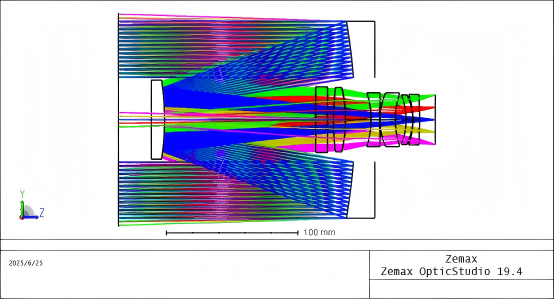
Avantier implemented a coaxial two-mirror reflective system integrated with a corrective lens group to eliminate aberrations and maximize image clarity.
  • Focal Length: 600 mm (Design baseline)
  • Field of View (FOV): 3.6°
  • Relative Aperture: f/4
  • Optical Dimensions: 150 mm × 150 mm × 200 mm
Optical System Structure Diagram

Performance Analysis

The system achieves near-diffraction-limited performance across the entire field of view:
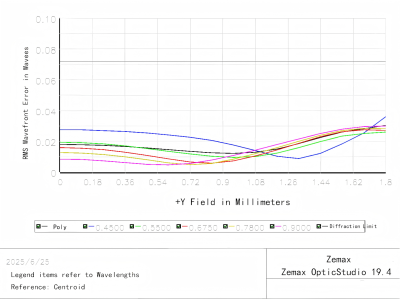
  • Wavefront Error: Sub-0.03λ @ 632.8nm RMS.
  • Achromatic Performance: Effective convergence from 450nm to 900nm without secondary spectrum residuals.
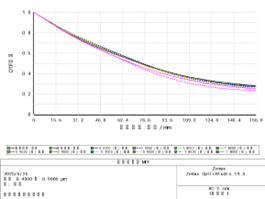
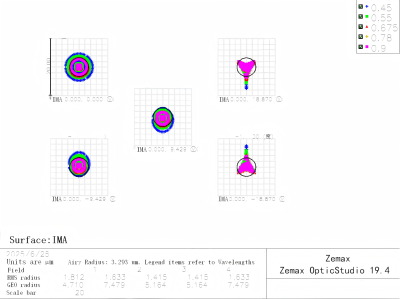
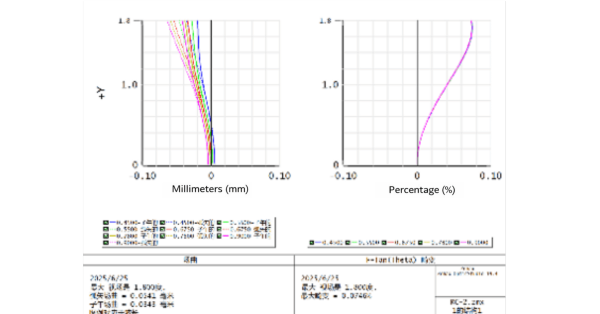
  • Image Quality: All field diffraction spots reach or approach the Airy disk size. Maximum distortion is contained below 0.1%, far exceeding the 2% requirement. MTF exceeds 0.22 at 156 lp/mm.
Wavefront aberration curve
MTF curve
Point sequence diagram
Field curvature distortion curve
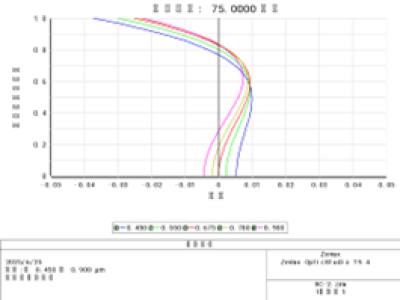
Axial aberration curve
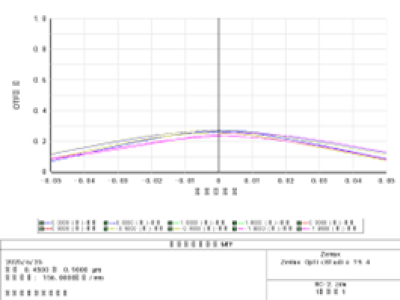
Defocus transfer function curve

Structural Design & Mechanical Integrity

The camera structure is engineered for extreme stability during launch and orbital operations, enduring vibration, microgravity, and vacuum thermal stresses.
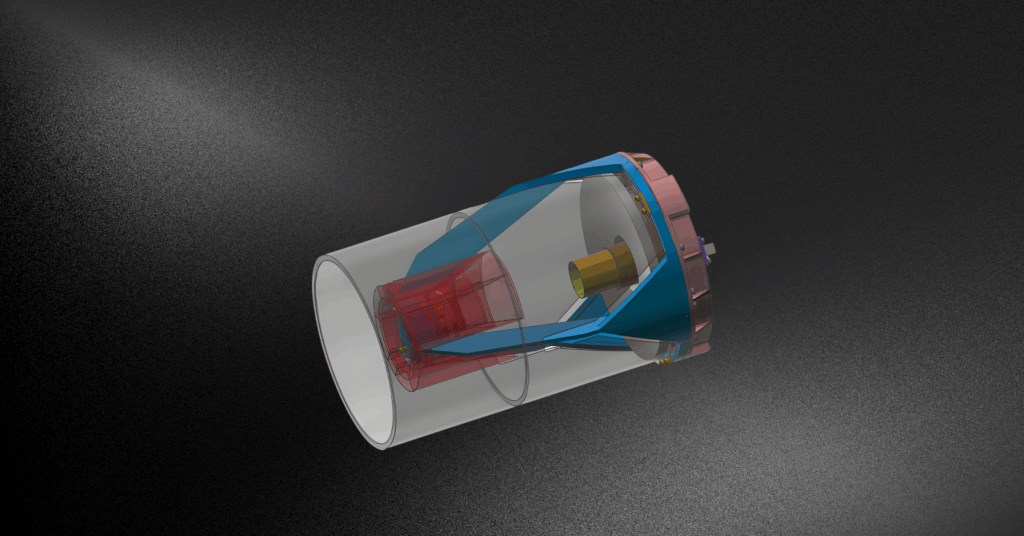
  • Box-Type Architecture: A primary load-bearing frame ensures high rigidity and avoids mutual interference between optical components.
  • Material Selection: Mirrors are crafted from zero-expansion microcrystalline glass, ensuring exceptional environmental adaptability and long-term focal stability.
  • Truss-Optimized Structure: High rigidity achieved through lightweight optimization.
Camera Structure Design

Table 3: Camera Mass Budget Distribution

Order

Component Name

Design Mass (kg)

1

Primary Mirror Assembly

0.60

2

Secondary Mirror Assembly

0.05

3

Correction Mirror Assembly

0.30

4

Main Support Structure

1.20

5

Prism Assembly

0.01

6

Light-shielding / Baffle

0.20

7

Thermal Control Subsystem

0.20

8

Fasteners (Bolts/Nuts)

0.04

Total


2.60 kg

Conclusion: Compliance & Success

The development resulted in a payload that not only met but surpassed all technical specifications, providing a significant performance margin for mission success.

Table 4: Indicator Compliance Matrix

Name

Technical Requirement

Design Value

Status

Effective Focal Length

580 mm

580 mm

Verified

Spectral Band (PAN)

450 nm – 900 nm

450 nm – 900 nm

Verified

MTF @ 156 lp/mm

> 20%

22%

Verified

Image Circle

37.5mm 

37.7 mm (GMAX3265 Ready)

Verified

Aperture

150 mm

150 mm

Verified

Total Envelope

< φ190 × 550 mm

φ185 × 300 mm

Verified

Total Mass

< 3.0 kg

2.6 kg

Verified

Max Throughput

> 76% 

76.54%

Verified

Distortion

< 2%

0.05%

Verified

Optimize Your Next Mission with Avantier Precision

Looking for a lightweight, high-performance optical solution for your satellite platform?

[Contact us for Detailed Technical Consultations]

GREAT ARTICLE!

Share this article to gain insights from your connections!