Breaking Conjugate Distance Limits for Quantum Imaging
Key Takeaways
Advanced optical design strategies can overcome traditional tradeoffs between long working distance and high numerical aperture.
Through multi-element aberration balancing, infinity-corrected architectures, advanced materials, and precision manufacturing, objective lenses can preserve imaging performance under constraints conventional designs cannot satisfy.
For quantum imaging systems, breaking conjugate distance limits is increasingly not just an optical improvement, but an enabling technology for system-level performance.
Advanced Objective Design Strategies for Long Working Distance, High-NA Quantum Systems
The limitations of conventional microscope objectives in quantum experiments are increasingly well understood. Less discussed is how those constraints can be overcome.
Among the most persistent challenges in quantum imaging is the traditional tradeoff between long working distance and high numerical aperture. In standard objective architectures, extending working distance generally comes at the cost of aberration control, collection efficiency, and diffraction-limited performance. For quantum systems operating through vacuum windows, within constrained beam geometries, and across multiple wavelengths, those penalties can become prohibitive.
Breaking this limitation requires more than incremental optimization. It requires rethinking objective design itself.
Recent advances in optical architecture, aberration control, materials engineering, and precision manufacturing have made it possible to extend conjugate distance limits while preserving performance required for demanding quantum applications.
Reframing Working Distance as a Primary Optimization Variable
In conventional optical design, long working distance is often treated as a performance compromise.
In advanced quantum imaging systems, it must instead be treated as a primary design variable.
That shift changes the optimization problem fundamentally.
Rather than preserving a conventional objective architecture while stretching its operating envelope, advanced designs redistribute optical power, rebalance aberration contributions across multiple elements, and optimize around the combined constraints of working distance, numerical aperture, and environmental interfaces.
This approach transforms what was traditionally a design limitation into an engineering parameter.
One enabling strategy is the use of multi-element architectures designed specifically to control aberrations that normally increase with longer optical paths.These designs typically combine:
Positive and negative lens group balancing
Chromatic correction across discrete operating wavelengths
Aspheric surface integration for spherical aberration suppression
Window-compensated optimization for vacuum interfaces
Rather than relying on conventional correction schemes, aberration control is distributed across the optical system.This is particularly important in quantum imaging, where residual aberrations affect not only image quality, but fluorescence collection, addressing precision, and readout performance.
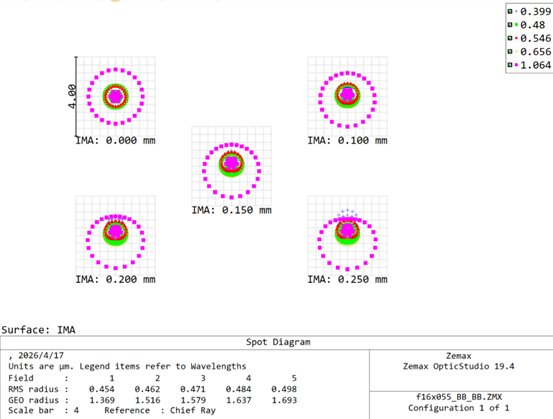
Point Array Diagram of Long Working-Distance Infinity Objective
Infinity-Corrected Optical Architectures Expand System Flexibility
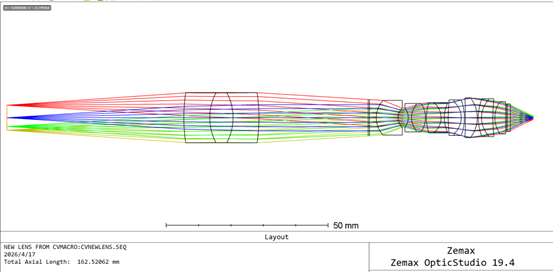
Infinity-corrected architectures are particularly effective in breaking conventional conjugate distance limits.By separating objective performance from downstream imaging optics through parallel beam propagation, these architectures enable:
Extended working distance without conventional finite-conjugate penalties
Integration with external optical components
Improved compatibility with complex experimental layouts
Greater flexibility in optimizing beam access and system geometry
In quantum systems, where objectives often coexist with additional optical subsystems, this flexibility can be critical.
Optical System Diagram of Infinity Objective Coupled with Tube Lens
Material Selection Becomes a Performance Enabler
Extending performance under long working distance conditions also depends on materials.High-performance optical materials such as fused silica enable:
Low dispersion behavior
High transmission across relevant wavelength ranges
Thermal stability
Compatibility with demanding environmental conditions
These properties become especially important in quantum applications involving vacuum operation, thermal sensitivity, or multi-wavelength correction requirements.Advanced coatings further contribute by minimizing reflection losses and preserving collection efficiency under low-photon conditions.
Performance must survive fabrication and assembly.
At long working distance and high numerical aperture, sensitivity to manufacturing tolerances increases substantially. Small errors in centration, surface accuracy, or assembly alignment can reintroduce the very aberrations the design seeks to suppress.
Precision manufacturing therefore becomes inseparable from optical performance.
High-accuracy component fabrication, controlled assembly, and tight coaxial tolerances are not implementation details.
They are part of the design solution.
Design Example: Long Working Distance High-Resolution Infinity Objective
A representative example illustrates how these strategies converge in practice.A long working distance infinity objective was developed with the following parameters:
Magnification: 20X
Numerical Aperture: 0.6
Working Distance: 3.5 mm (fused silica + 9 mm air)
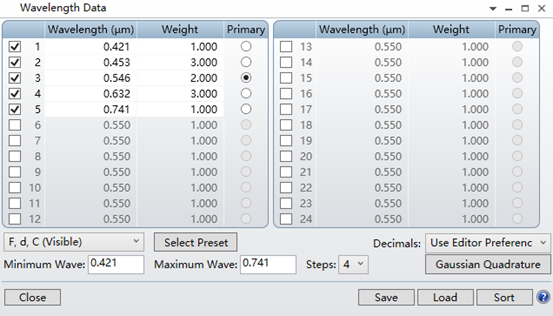
Wavelength Range: 421–741 nm
Entrance Pupil Diameter: 12 mm
Object-Side Field of View: 0.5 mm
The design combines multi-element aberration correction, infinity conjugate architecture, fused silica optics, and high-performance coatings to preserve imaging performance under extended conjugate conditions.Performance validation is reflected in optical modeling and measured system behavior.
Optical Band Weight Distribution
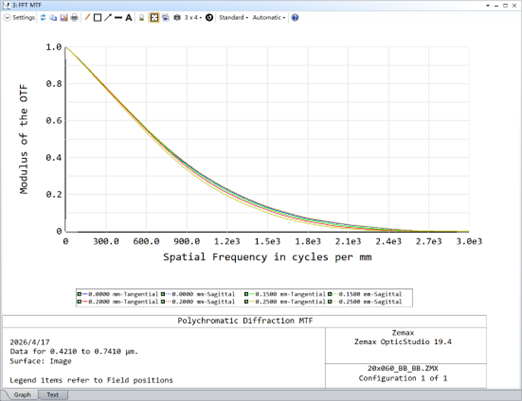
MTF Performance
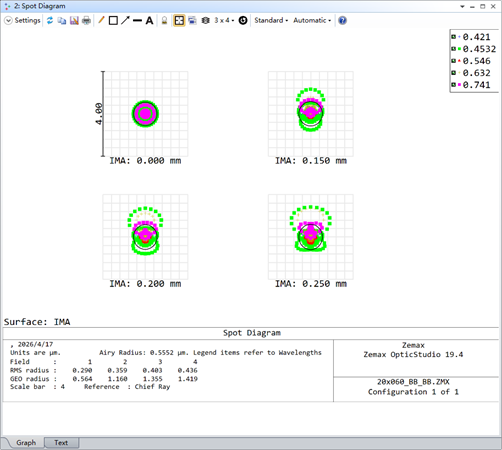
Point Sequence Diagram
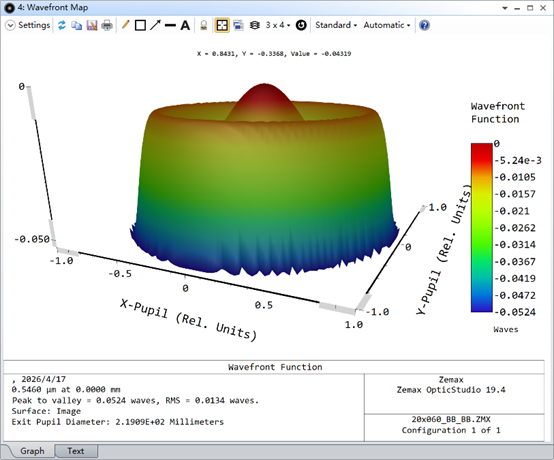
Wavefront Aberration Performance
These results illustrate that extended working distance need not imply compromised imaging performance when objective architecture is designed around the constraint itself.
For quantum systems, the significance extends beyond better objectives.These design approaches affect:
State Detection Performance
Higher collection efficiency and controlled aberrations support improved readout fidelity.
Optical Access Preservation
Objective geometry and extended conjugate design can reduce conflicts with beam delivery architectures.
Vacuum-Compatible Imaging
Window compensation and long working distance optimization support imaging through constrained experimental interfaces.
System-Level Scalability
Optical architectures that preserve performance while relaxing geometry constraints support more scalable system designs.At this point, objective design is no longer simply a component-level concern.It becomes part of quantum system architecture.
Toward Application-Specific Quantum Objectives
What is emerging is a shift away from adapting conventional microscope objectives to quantum systems, toward designing objectives specifically for quantum constraints.
That distinction matters. Because breaking conjugate distance limits is not simply about extending working distance. It is about enabling optical performance under conditions where conventional assumptions no longer hold. And increasingly, that is becoming a prerequisite for advanced quantum hardware.
Conclusion
The traditional tradeoff between long working distance and high numerical aperture has long constrained objective performance.
Advanced optical design strategies are beginning to change that.
Through multi-element aberration balancing, infinity-corrected architectures, advanced materials, and precision manufacturing, conjugate distance limits can be pushed beyond what conventional objectives allow—without sacrificing the performance quantum imaging systems require.