
Key Takeaways
- This case study shows how custom objective lens design addressed simultaneous constraints involving long working distance, high numerical aperture, beam access, multi-wavelength performance, and non-magnetic compatibility in an ultracold atom experiment.
- By combining optical optimization, mechanical iteration, and collaborative engineering support, the solution enabled integration where standard objectives could not, illustrating how application-specific optics increasingly support advanced quantum research.
Enabling High-NA Quantum Imaging Under Tight Geometric and Experimental Constraints
Advanced quantum experiments often push well beyond the operating limits of conventional optical components. In ultracold atom systems, microscope objectives must satisfy not only demanding imaging requirements, but also complex constraints imposed by beam access, vacuum interfaces, material compatibility, and overall experimental architecture.
In this project, a research group developing an ultracold atom experimental platform required an objective lens solution that conventional designs could not provide.
Rather than adapting a catalog objective to fit the experiment, the solution required development around the experiment itself.
Customer Background
The customer is a research organization focused on quantum physics, with applications involving ultracold atom experiments and advanced optical systems.
Their experimental platform required precision imaging and optical access under conditions that exceeded the capabilities of standard commercial objectives.
The project involved integrating a high-performance objective into a highly constrained quantum experimental environment where optical performance and mechanical geometry were equally critical.
The Challenge
The customer faced multiple simultaneous design constraints that conventional microscope objectives could not satisfy.Beam Path Obstruction from Standard Objective Geometry
Existing objective designs introduced physical interference with critical laser beam paths in a confined experimental layout. This created conflicts with beam routing required for:- Optical trapping
- Cooling and repumping
- Quantum state control
Long Working Distance Requirement with High Numerical Aperture
The system required a working distance of at least: ≥12 mm through a quartz window while maintaining:- Numerical aperture of 0.65
- Resolution target of 1.2μm
- Collection efficiency target of >85%
Multi-Wavelength Optical Performance Requirements
The experiment required performance across multiple operating wavelengths, including:- 780 nm
- 852 nm
- 1064 nm
- Aberration correction
- Transmission efficiency
- Wavelength-specific optical optimization
Non-Magnetic Material Constraints
Because of the sensitivity of the quantum system, magnetic compatibility was also required. Standard materials and assembly approaches presented unacceptable risk of experimental interference. This introduced constraints extending beyond optical design alone.Solution Approach
A semi-custom / custom objective solution was developed specifically around the experimental constraints.
Rather than modifying a standard objective, the solution combined optical, mechanical, and material optimization as part of an integrated engineering effort.
Optical Design Optimization
The optical design was optimized around the combined requirements for:
- High numerical aperture
- Extended working distance
- Quartz window compensation
- Multi-wavelength aberration correction
Design development included:
- Optical simulation
- Prescription optimization
- Coating design
- Tolerance analysis
Target specifications included:
- NA: 0.65
- Working Distance: 14mm
- Wavelength Range 700-1100 nm
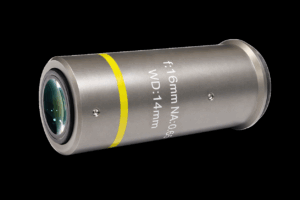
Mechanical Geometry Optimization
Mechanical iteration focused on preventing beam obstruction while preserving optical performance.
This included optimization of:
- Lens tip geometry
- Housing architecture
- Front-end mechanical envelope
- Mounting/interface options
Multiple design iterations were evaluated to align optical performance with experimental beam access requirements.
Non-Magnetic and Manufacturability Considerations
The solution also addressed material and implementation constraints through:- Non-magnetic material selection
- Manufacturability planning
- Assembly tolerance analysis
- Integration compatibility review
Engineering Collaboration and NRE Support
The project included full NRE engineering support throughout development. Deliverables included:- Performance reports
- Optical modeling results
- CAD integration files
- Tolerance analyses
- Procurement and acceptance planning documentation
- Acceptance criteria
- Technical milestones
- Delivery expectations
- Integration requirements
Results
The resulting custom objective solution achieved:Optical Performance
- Working Distance: 14mm
- Numerical Aperture: 0.65
- Transmission Performance: >90%
- Aberration Performance: Diffraction limit correction
Mechanical Integration
- Beam path clearance preserved for 5 beam geometries
- Objective geometry integrated within experimental constraints
- No obstruction of critical laser access paths
Experimental Compatibility
- Non-magnetic requirements satisfied
- Vacuum / quartz window requirements satisfied
- Multi-wavelength performance achieved
Impact
The resulting solution enabled the research team to implement an objective architecture aligned with the requirements of the experiment, rather than forcing the experiment to accommodate the limitations of conventional optics. This supported:- Improved optical access
- Preservation of imaging performance
- Reduced integration risk
- Progress toward experimental objectives in BEC and quantum simulation
Conclusion
Conventional microscope objectives often struggle to meet the simultaneous demands imposed by advanced quantum experiments.
In this project, requirements involving long working distance, high numerical aperture, multi-wavelength correction, beam access, and non-magnetic compatibility could not be met using standard solutions.
By combining custom optical design, mechanical optimization, and collaborative engineering support, a solution was developed around the experiment itself.
For advanced quantum research systems, that distinction is often what makes integration possible.
Related Content