

Key Takeaways
- This opto-mechanical engineering case demonstrates the importance of tightly coupled optical and mechanical design for 360° imaging systems.
- Precise entrance pupil and rotation axis control are critical for parallax-free stitching.
- Early CAD synchronization reduces integration risk, while DFM-driven decisions improve manufacturability, cost, and delivery timelines.
- System-level optimization—including mass distribution and packaging—ensures performance translates into scalable production.
In the high-performance panoramic imaging and digital camera optics market, a customer required a custom ultra-wide-angle lens design to enable precision 360° imaging using a multi-shot capture workflow. The system architecture relied on capturing three images at 120° intervals with parallax-free stitching, placing stringent demands on both optical design accuracy and opto-mechanical integration.
Optical Design Requirements: IMX571, 174° FOV, and 132 lp/mm Resolution
The optical system was developed around the Sony IMX571 sensor, targeting 132 lp/mm resolution to support high-frequency detail across the image plane. The lens achieved an ultra-wide 174° field of view, requiring advanced control of aberrations, distortion, and field curvature.
A critical requirement was precise alignment of the entrance pupil relative to the rotation axis. Sub-millimeter deviations would introduce parallax errors, directly impacting stitching accuracy and degrading downstream image processing performance.
Opto-Mechanical Integration and Precision Alignment Challenges
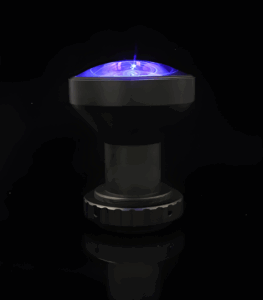
The project required a tightly coupled opto-mechanical design workflow. The lens assembly needed to be integrated into a custom housing with an M42 × 0.75 mount, while maintaining strict tolerances on axial and radial alignment. Key mechanical constraints included:- Optimized mass distribution and center of gravity
- Integration of locking ring mechanisms and wrench access
- Compatibility with custom enclosure geometries and protective cap systems
Engineering Constraints: Speed, Manufacturability, and Cost Optimization
The customer faced multiple advanced development constraints:- Rapid CAD delivery to support parallel camera housing development
- Optimization for design for manufacturability (DFM) and cost targets
- Weight reduction and structural efficiency
- Consideration of packaging and environmentally sustainable lens cap design
Solution: From Optical Concept to Manufacturable Lens Assembly
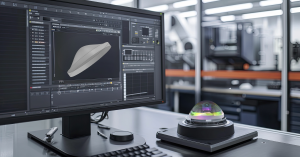
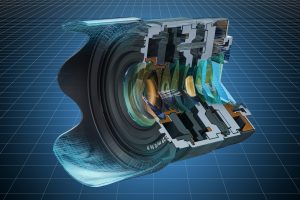
Our approach focused on transitioning the design from optical concept to production-ready opto-mechanical system. We validated key parameters—including field of view, entrance pupil position, and rotation axis alignment—to ensure system-level performance. We maintained strict co-registration between optical models and mechanical CAD, reducing iteration cycles and minimizing integration risk. On the mechanical side, we refined:- Locking ring geometries for secure mounting
- Front-edge fillets for durability and handling
- Tool access features for assembly efficiency
Production Considerations: Packaging, Cap Design, and Sample Delivery
Practical engineering considerations were addressed early in the process. This included:
- Redesigning the lens cap structure for lower cost and reduced material usage
- Improving environmental sustainability of packaging components
- Planning sample delivery timelines aligned with the customer’s development schedule
Results: High-Performance Custom Lens with Robust System Integration
The final result was a custom ultra-wide-angle lens that met demanding optical and mechanical requirements while remaining viable for production. The system delivered:- High-resolution imaging at 132 lp/mm
- Accurate parallax-free panoramic stitching
- Reliable mechanical integration within custom housing
Start Your Opto-Mechanical Engineering Project
Need support with advanced opto-mechanical engineering or custom lens development? Our team specializes in high-performance optical systems, from concept through manufacturable design. Get in touch to discuss your requirements.

GREAT ARTICLE!
Share this article to gain insights from your connections!