

Key Takeaways
- Hybrid 1-glass–3-plastic architecture reduces size and weight while maintaining optical performance. System-level design aligns FOV (48°) and focal length (4.65 mm) with human vision.
- Aspherical surfaces and tight tolerances (down to ~3 μm) control aberrations and ensure alignment. Low-reflection coatings (≤0.5%) improve transmission and limit stray light.
- The design supports stable performance from −10°C to 65°C. End-to-end workflow—from simulation to fabrication and assembly—enables repeatable scaling from prototype to production.
Custom Optical Systems for AR Devices: High-Precision Design and Scalable Manufacturing
As a leader in optical R&D and manufacturing, Avantier has continuously advanced optical technologies for augmented reality systems. Leveraging decades of expertise in optical design, precision fabrication, and integrated delivery capabilities, we provide custom optical systems for AR devices tailored to real-world application requirements.
The latest optical system architecture incorporates a scientifically optimized 1-glass–3-plastic hybrid design, micron-level tolerance control, and high-transmission, low-reflection coating technologies. This integrated approach enables significant improvements in both optical performance and manufacturability, providing a robust foundation for next-generation AR devices.
For an overview of AR/VR optical fundamentals, refer to: Advanced Optical Solutions for AR/VR/MR Devices
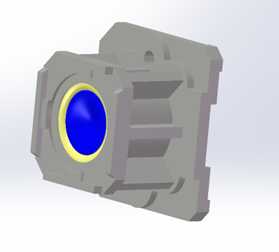
Designing Custom Optical Systems for AR Applications
AR devices impose stringent constraints on optical systems, including compact form factor, lightweight structure, high imaging performance, and environmental robustness. At the same time, optical systems must align with human visual perception to ensure a natural and comfortable viewing experience. To address these requirements, Avantier adopts a system-level design approach based on real usage scenarios and human–machine interaction characteristics. The optical architecture utilizes a hybrid configuration consisting of one glass lens and three plastic lenses. The glass element is fabricated using high-performance D-ZK3 material, while the plastic elements use specialized optical polymers such as OKP-1 and APL5014CL. This configuration maintains optical precision while significantly reducing system weight and size—making it well suited for head-mounted AR devices. Key system parameters are carefully optimized:- Total field of view: 48° (35° horizontal and vertical)
- Focal length: 4.65 mm
- Operating temperature range: -10°C to 65°C
Multidimensional Precision Design for Optical Performance
To translate system-level design into high-performance optical hardware, Avantier integrates four core engineering methodologies:- Advanced optical simulation
- Precision structural design
- Tight tolerance control
- Customized coating processes
Aspherical Surface Optimization
The four-element optical system incorporates eight optical surfaces, each precisely modeled using aspherical equations. Surface parameters—including conic constants and higher-order coefficients (A4, A6, A8, etc.)—are optimized to correct aberrations and improve imaging performance.Structural Parameter Definition
Each optical element is defined through precise control of:- Center thickness
- Radius of curvature
- Clear aperture
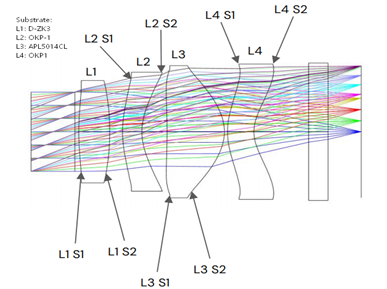
Parameter for Each Lens
Item |
Unit |
L1 |
L2 |
L3 |
L4 |
Center thickness |
mm |
0.80 |
0.50 |
1.48 |
0.68 |
S1 Radius |
mm |
8.535 |
3.924 |
-19.175 |
2.405 |
S2 Radius |
mm |
-8.124 |
2.096 |
-1.496 |
1.234 |
Conic @S1 |
– |
– |
– |
– |
– |
Conic @S2 |
– |
– |
– |
-3.62 |
-3.90 |
Clear aperture diameter @S1 |
mm |
2.8 |
3.5 |
3.8 |
4.0 |
Clear aperture diameter @S2 |
mm |
3.1 |
3.6 |
4.0 |
4.1 |
Micron-Level Tolerance Engineering
High-performance AR optical systems require strict control of manufacturing and assembly tolerances. Avantier implements micron-level precision standards across all critical parameters:- Center thickness tolerance: as low as 3 μm
- Curvature deviation: ≤ 1 μm
- Surface irregularity (RMS): ≤ 0.050 μm
Lens and Assembly Tolerance Table
Item |
Unit |
L1 |
L2 |
L3 |
L4 |
Lens center thickness |
um |
7 |
3 |
3 |
3 |
Surface radius deviation |
um |
1 |
1 |
1 |
1 |
Irregularities RMS |
um |
0.050 |
0.050 |
0.050 |
0.050 |
Surface PV |
um |
0.20 |
0.30 |
0.30 |
0.30 |
Surface tilt (ETD) |
arcmin |
1.5 |
1.5 |
1.5 |
1.5 |
Surface decenter |
um |
5 |
3 |
3 |
3 |
Refractive index |
– |
0.001 |
0.001 |
0.001 |
0.001 |
Abbe number |
% |
1 |
1 |
1 |
1 |
Air spacing |
um |
10 |
10 |
10 |
10 |
Element decenter |
um |
4 |
4 |
4 |
4 |
Element tilt |
arcmin |
3.5 |
3.5 |
3.5 |
3.5 |
Optical Coating Design and Performance
To meet system-level optical requirements, customized multilayer coatings are applied based on the angle of incidence (AOI) across each optical surface. Performance targets include:- Reflectivity ≤ 0.5% (430–670 nm)
- Reflectivity ≤ 0.2% (525 nm)
Coating Requirements
Item |
L1-S1 |
L1-S2 |
L2-S1 |
L2-S2 |
L3-S1 |
L3-S2 |
L4-S1 |
L4-S2 |
Max AOI |
26.5 |
30.7 |
29.3 |
44.6 |
45.5 |
44.8 |
30.9 |
42.0 |
R(max) @430–670 nm |
0.5% |
0.5% |
0.5% |
0.5% |
0.5% |
0.5% |
0.5% |
0.5% |
R(max) @525 nm |
0.2% |
0.2% |
0.2% |
0.2% |
0.2% |
0.2% |
0.2% |
0.2% |
System Performance Specifications
The optimized optical system delivers high-performance imaging suitable for AR applications:- Focal length: 4.65 mm
- F-number: 1.93
- Field of view: 35° × 35° (48° diagonal)
- Wavelength range:
- 470 nm ±15 nm
- 525 nm ±23 nm
- 604 nm ±25 nm
From Prototype to Mass Production
Avantier provides a complete delivery system for custom optical systems, covering:
- Optical design and optimization
- Precision fabrication (glass and plastic)
- Coating and assembly
- Performance validation
Rapid Prototyping
Standard AR optical system samples can be delivered with continuous design iteration support.
Scalable Manufacturing
Advanced facilities support:
- Injection molding of optical plastics
- Precision grinding of glass optics
- Batch coating processes
- Automated assembly
Quality Assurance
A comprehensive quality system ensures performance consistency across all stages—from raw materials to final validation.
Advancing Optical Systems for AR Devices
Avantier continues to advance optical technologies for AR applications, focusing on:- Miniaturization
- High resolution
- Wide field of view
- Energy efficiency
Related Content




GREAT ARTICLE!
Share this article to gain insights from your connections!