

Technical Deep Dive: The Evolution of Space Laser Terminal Architecture
While the fundamental advantages of Free-Space Optical Communication (FSOC)—such as high bandwidth and RF-jamming immunity—are well-established (see our FSOC Fundamentals), the industry is now shifting from “proving the physics” to “optimizing the architecture.”
For aerospace engineers and system architects, the challenge has moved beyond simple Pointing, Acquisition, and Tracking (PAT) to the scalability, manufacturability, and intelligence of the terminals themselves.
The Three Generations of Terminal Design
The development road of space laser communication is defined by three distinct architectural shifts. Each generation addresses a specific trade-off between performance, reliability, and cost.
Feature |
Gen 1: Coarse-Fine Hybrid |
Gen 2: Integrated Systems |
Gen 3: Modular & Scalable |
Focus |
Stability & Range |
SWaP-C Optimization |
Mass Production & Networking |
Tracking |
Two-stage (Active/Passive) |
System-level integration |
AI-driven / Software-defined |
Weight |
High (Bulky payloads) |
< 10 kg |
Ultra-light / Modular |
Typical Rate |
Validation speeds |
~10 Gbps |
100 Gbps+ |
Best Use Case |
Deep Space / Early Experiments |
LEO Constellations |
Proliferated Space Mesh Networks |
Looking for flight-proven laser communication terminal architectures?
Explore Avantier’s Cube-Type, T-Shaped, and P-Shaped laser communication terminals for smallsat, LEO, and inter-satellite missions.
1. Coarse-Fine Hybrid Architecture: The Validation Pioneer
Early systems prioritized link reliability over physical footprint. By separating active and passive components, these terminals use a two-stage approach:- Coarse Module: Leverages the satellite’s attitude control for initial capture.
- Fine Module: Employs high-frequency galvo-mirrors for kHz-level vibration suppression.
2. Integrated Architecture: The Industrialization Catalyst
To meet the demands of commercial LEO orbits, the industry moved toward system-level integration. This shift was powered by advancements in ASICs, FPGAs, and compact reflective optics.- Key Innovation: Deep integration of optical, electronic, and control subsystems.
- Performance Leap: Reduced costs to the hundreds of thousands (USD) and latency to millisecond levels.
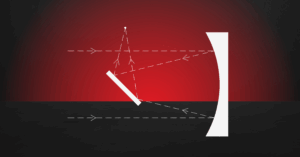
- Terrestrial Synergy: This architecture extends to ground terminals, such as the three-mirror reflective design, which decouples moving telescopes from stationary optical paths to enhance tracking bandwidth and simplify thermal management.
3. Modular & Scalable Architecture: Software-Defined Networking
The current frontier is the standardized, modular terminal. By adopting “plug-and-play” modules and Software-Defined Radio (SDR) principles, engineers can now extend mission lifecycles without hardware redesigns.- Scalability: Standardized interfaces for optical heads, controllers, and signal processors.
- Manufacturing: Development cycles have been compressed from 24 months to mere months.
- Multi-Link Capability: Supports high-density data exchange (100Gbps+) and simultaneous multi-node connections.
The Future: Intelligent & Autonomous Mesh Nodes
The next generation of terminals will function as intelligent network nodes rather than simple transceivers.- AI-Enhanced PAT: Utilizing model-predictive control and AI algorithms to compress link establishment time to sub-millisecond precision.
- Adaptive Networking: Integration with Software-Defined Networking (SDN) to allow autonomous topology reconfiguration during satellite failures or orbital shifts.
- Cross-Scenario Adaptability: A single terminal design capable of switching between space-to-space, space-to-ground, and air-to-ground modes via modular software updates.
Avantier’s Engineering Support
Designing the next generation of space laser terminals requires more than just high-quality lenses. At Avantier, we provide the precision opto-mechanics necessary for Gen 2 and Gen 3 architectures, including:
- Athermalized Lens Assemblies for stable performance across extreme thermal gradients.
- Silicon Carbide (SiC) Optics for ultra-lightweight, high-stiffness telescope systems.
- Custom Beam Steering Modules with embedded Fast Steering Mirrors (FSM).
Ready to optimize your terminal architecture?
Explore Laser Communication Terminals
Discuss Your SWaP-C and Pointing Requirements

GREAT ARTICLE!
Share this article to gain insights from your connections!