The 114° Ceasefire: Where Optical Ambition Meets Production Reality
Key Takeaways
The 114° Threshold: Not a choice, but a physical “ceasefire” where optical ambition meets manufacturing reality.
Physics of cos4 θ: Peripheral light loss and chromatic aberration form the primary “wall” for ultra-wide FOV.
Manufacturing Limits: Steep “Sag Values” in aspherical molding dictate production yields; 1% more FOV can drop yield to zero.
Engineering Legacy: True completion involves documenting these boundaries as organizational assets to empower the next generation of innovators.
Why do we always end up at 114°?
In optics, nobody officially declared 114° (14mm on full-frame) the standard. And yet, design after design quietly converges there. Not because we like the number, but because that’s where physics, manufacturability, and sanity reach a temporary ceasefire.
Marketing calls it a “dramatic wide view.” On the engineering floor, it’s where things stop breaking. When you try to push the Field of View (FOV) just a little further, everything begins to argue at once:
Illumination falls off.
Distortion balloons.
Aspheres get too steep to mold.
Yield starts whispering threats.
114° isn’t a milestone. It’s a line drawn between the laws of physics and the capabilities of the factory floor. To push an FOV by even 1% is not a simple adjustment; it is a high-stakes battle over every millimeter of glass.
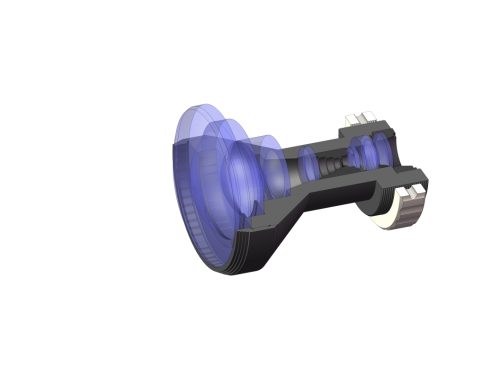
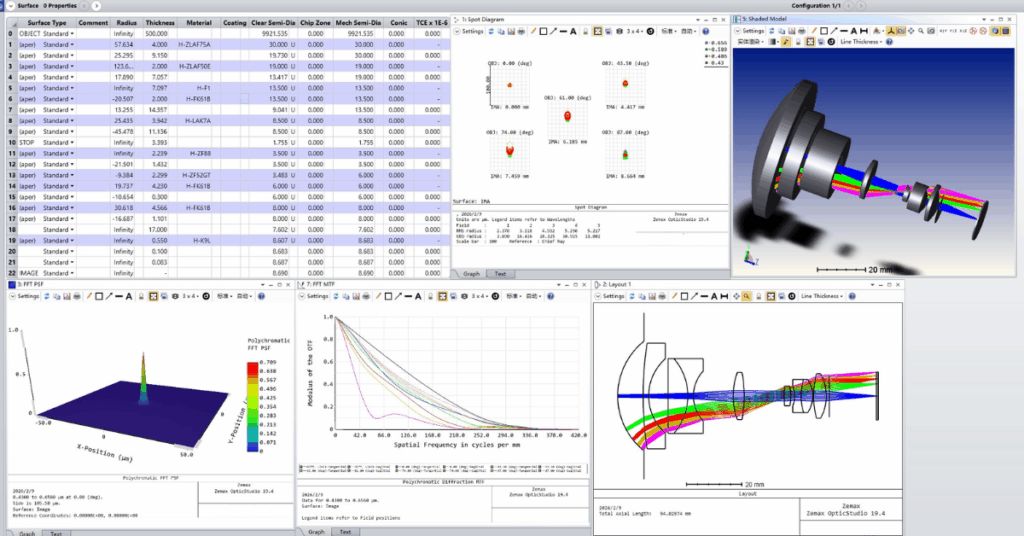
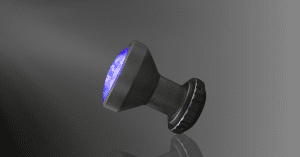
A 3D optical drawing of Wide angle lens
1. The Desperate War Against the “Cosine Fourth Law” (cos4 θ)
The primary enemy of wide-angle design is physics itself. As the angle of incidence increases, peripheral illumination decreases proportionally to the fourth power of the cosine of the angle. By the time you cross the 110° threshold, light at the edges is physically struggling to “reach” the sensor.
To break this limit, engineers must increase the size of the front element to “force-bend” light. However, this triggers a secondary crisis: Lateral Chromatic Aberration. The struggle to balance edge illumination with color fidelity is the first “wall” where many designs fail.
2. The “Sag Value” Crisis: When the Press Cries Out
Even the most perfect optical simulation must eventually face the reality of the aspherical molding process. In ultra-wide designs, the curvature of the lens becomes increasingly steep toward the periphery. This brings us to the Sag Value (the depth of the curve).
The Yield Threshold: If the curve is too steep, the glass will not release properly from the mold, or micro-cracks will form during cooling.
The Precision Gap: A deviation of just a few microns in curvature can drop production yield from 80% to 0%.
Engineers often have to sacrifice 0.5% of theoretical optical perfection just to make the lens “manufacturable” as a reliable asset.
3. The Mirrorless Revolution: Redefining Light Paths
The transition to mirrorless systems has moved the goalposts. By eliminating the mirror box and shortening the flange focal distance, we can now place the rear element millimeters away from the sensor.
This improved telecentricity allows light rays to strike the sensor more vertically, effectively pushing the “14mm wall” down to 12mm or even 10mm. Yet, this creates a new engineering frontier: managing the nano-scale interference between the exit pupil and the sensor’s micro-lens array.
Conclusion: Completion as a Technical Asset
The 114° benchmark is not a fixed law; it is a record of the current “state of the art” where physics, material science, and manufacturing cost intersect.
True “completion” of a project means documenting these technical thresholds so that the next generation of engineers doesn’t just inherit a product—they inherit a map of the boundaries. We fight for that extra 1% of FOV not just for the image, but to expand the technical assets of the system itself.
Technical Inquiry & Consultation
Have you reached a manufacturing threshold? Let’s discuss the physics of the solution.
We welcome deep-dive technical questions and discussions regarding specific thresholds, optical limits, or the feasibility of extreme wide-angle designs. Our engineering team is ready to engage in peer-to-peer discourse on how to push the boundaries of current optical systems.