SiC vs. Zerodur: A Material Comparison for Space and Defense Optical Systems
Key Takeaways
Silicon Carbide (SiC) offers high stiffness, low weight, and excellent thermal conductivity, making it ideal for dynamic and lightweight space or defense systems.
Zerodur, with its near-zero thermal expansion, provides exceptional dimensional stability in controlled environments.
The choice depends on whether the application prioritizes rapid thermal equilibrium and structural efficiency (SiC) or absolute stability under uniform temperatures (Zerodur).
Introduction
In high-performance optical systems—particularly in spaceborne and defense applications—material selection is a critical driver of system performance, stability, and cost. Two of the most widely used materials for precision mirrors and structural optics are Silicon Carbide (SiC) and Zerodur®.
While both materials are capable of delivering exceptional optical performance, they differ fundamentally in their thermal behavior, mechanical properties, and manufacturing characteristics. This article provides a practical comparison tailored to engineering decision-making.
Material Overview
Silicon Carbide (SiC)
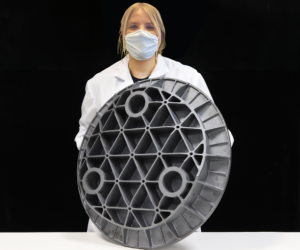
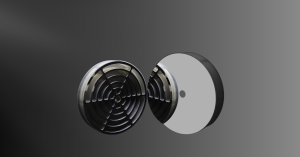
A lrage sic mirror
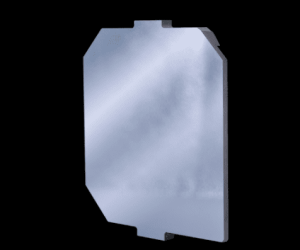
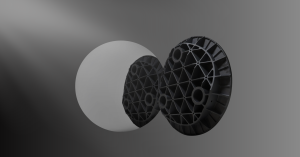
A Silicon Carbide Mirror(Front)
Silicon Carbide is a high-performance ceramic known for its extreme stiffness, low density, and high thermal conductivity. It has become increasingly popular in modern space telescopes and defense imaging systems.Key characteristics:
Density: 3.02~3.21g/cm3
Young’s Modulus: 345~400GPa
Thermal Conductivity: 120~180W/(m·K)
Coefficient of Thermal Expansion (CTE): 2.4~4.0×10⁻⁶ /K
Zerodur®
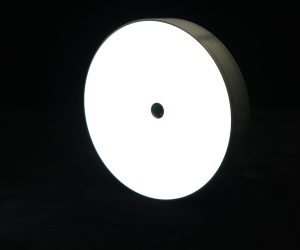
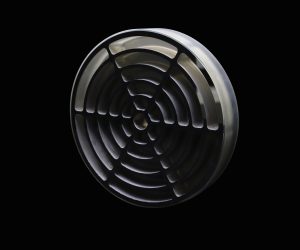
Light Weight Zerodur Mirror
Light Weight Zerodur Mirror
Zerodur is a glass-ceramic material engineered for near-zero thermal expansion, making it a long-standing standard in high-precision optical systems.Key characteristics:
Density: 2.53g/cm3
Young’s Modulus: 90.3~92GPa
Thermal Conductivity: 1.46~1.64W/(m·K)
Coefficient of Thermal Expansion (CTE):0±0.02×10⁻⁶ /K
Key Performance Comparison
Property
Silicon Carbide (SiC)
Zerodur®
Thermal Expansion (CTE)
Low but non-zero 2.4×10⁻⁶ /K
Near-zero 0.02×10⁻⁶ /K
Thermal Conductivity
Very high 120~180W/(m·K)
Very low 1.46W/(m·K)
Specific Stiffness
Very high
Moderate
Weight Reduction Capability
Excellent (lightweight structures)
Limited
Thermal Stability Mechanism
Rapid heat equalization
Minimal expansion
Manufacturability
Complex, requires advanced processes
Mature, well-established
Heritage
Increasing in space systems
Extensive legacy
Thermal Behavior: The Core Trade-off
The most critical difference between SiC and Zerodur lies in how they handle thermal effects.
Zerodur minimizes dimensional change due to its near-zero CTE.
SiC, while having a higher CTE, compensates with extremely high thermal conductivity, allowing it to quickly equalize temperature gradients.
Engineering implication:
Zerodur is inherently stable under uniform temperature changes.
SiC performs well in dynamic or non-uniform thermal environments, where gradients dominate.
Structural and Mass Considerations
Weight and stiffness are especially critical in space and airborne defense systems.
SiC
High stiffness-to-weight ratio
Compatible with lightweight designs (e.g., ribbed or honeycomb structures)
Enables aggressive mass reduction
Zerodur
Heavier and less stiff
Typically used in monolithic or semi-lightweighted forms
Conclusion:SiC is generally preferred where mass and structural rigidity are key constraints.
Manufacturing and Processing
SiC
Requires advanced techniques such as sintering, CVD coating, and precision grinding
Polishing often involves additional layers (e.g., Si coating)
Longer and more complex production cycles
Zerodur
Can be polished directly to optical quality
Extensive industrial base and proven processes
Lower manufacturing risk
Application Suitability
Silicon Carbide (SiC) is preferred for:
Space telescopes with rapid thermal cycling
Earth observation satellites
Defense imaging systems requiring lightweight and high stiffness
Systems with active thermal control or transient environments
Zerodur® is preferred for:
Ground-based telescopes
Lithography and semiconductor optics
Ultra-stable environments with minimal thermal gradients