

Key Takeaways
- Custom long-wave infrared (LWIR) space telescopes are critical for advanced aerospace remote sensing applications, including Earth observation, environmental monitoring, and target detection.
- Designing these systems requires overcoming significant challenges in thermal stability, infrared material selection, aberration correction, dual-band performance, and space-environment survivability.
- Through advanced optical design, passive athermalization, precision aspherical manufacturing, aerospace-grade coatings, and rigorous qualification processes, high-performance LWIR optical systems can achieve reliable operation in demanding mission environments.
- An integrated engineering approach is essential for transforming ambitious performance requirements into flight-ready optical solutions.
From Optical Design to Space Qualification
Long-wave infrared (LWIR) imaging systems operating in the 7–12 μm spectral range play a critical role in modern aerospace and remote sensing applications. Their ability to detect thermal radiation independently of visible illumination makes them indispensable for Earth observation, environmental monitoring, target detection, space surveillance, and meteorological analysis.
As aerospace missions demand higher imaging performance, longer operational lifetimes, and reduced payload mass, standard commercial infrared optics are often unable to meet the required specifications. Custom-engineered LWIR telescope systems are therefore becoming essential for next-generation spaceborne and airborne platforms.
At Avantier, we specialize in the design, manufacturing, assembly, and qualification of high-performance infrared optical systems. This article examines the technical challenges involved in developing a custom LWIR telescope for aerospace applications and demonstrates how an integrated engineering approach transforms demanding requirements into flight-ready optical solutions.
New to space optical payloads? Read our guide to Space Optical Remote Sensing Payloads.
Why LWIR Telescopes Are Important for Aerospace Remote Sensing
Unlike visible imaging systems, LWIR sensors capture thermal emissions generated by objects themselves. This capability enables reliable imaging during both day and night and under challenging atmospheric conditions.
Typical applications include:
- Earth observation and environmental monitoring
- Wildfire detection and disaster management
- Meteorological observation
- Maritime surveillance
- Space situational awareness
- Defense and target recognition systems
- High-altitude airborne sensing platforms
To support these missions, optical systems must deliver high sensitivity, excellent image quality, thermal stability, and long-term reliability in harsh operating environments.
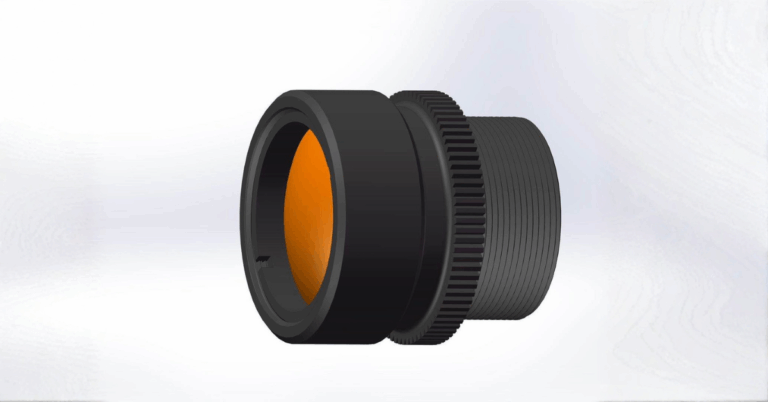
Example System Requirements
Consider a representative aerospace LWIR telescope with the following specifications:
Parameter | Specification |
Spectral Range | 7–12 μm |
Dual-Band Coverage | 7–9 μm and 10–12 μm |
Effective Focal Length | 380 mm |
F-Number | F/2 |
Field of View | 0.8°–1.6° |
Energy Encirclement | ≥88% within 60 μm |
Operating Temperature | 0°C to 50°C |
Weight Target | ≤2 kg |
Space Qualification | Radiation, vibration, and vacuum compatible |
Although these specifications may appear straightforward individually, achieving all of them simultaneously presents significant engineering challenges.
Key Engineering Challenges
1. Limited Material Choices in the LWIR Band
Unlike visible optics, long-wave infrared systems can only utilize a relatively small number of optical materials.
Common candidates include:
- Germanium (Ge)
- Zinc Selenide (ZnSe)
- Chalcogenide Glasses
- AMTIR Materials
Each material presents tradeoffs involving:
- Refractive index
- Dispersion
- Thermal sensitivity
- Radiation resistance
- Mechanical durability
Germanium, for example, offers excellent infrared transmission and high refractive power but exhibits a large temperature-dependent refractive index shift, making thermal compensation particularly challenging.
* AMTIR® is a registered trademark of Amorphous Materials, Inc.
2. Large-Aperture Aberration Correction
A 380 mm F/2 telescope operates in a regime where aberrations become increasingly difficult to control. Engineers must simultaneously manage:- Spherical aberration
- Coma
- Astigmatism
- Field curvature
3. Passive Thermal Stability
One of the most demanding requirements for aerospace optics is maintaining focus over large temperature variations without active refocusing mechanisms. In orbit, temperature fluctuations can easily degrade image quality if thermal effects are not properly compensated. A successful passive athermalization strategy requires:- Careful material pairing
- Controlled optical power distribution
- Structural thermal matching
- Precision mechanical design
4. Dual-Band Performance Optimization
Supporting both the 7–9 μm and 10–12 μm bands within a single optical architecture significantly increases design complexity. Because dispersion behavior differs across the two wavelength ranges, designers must balance image quality simultaneously in both bands. This often requires:- Multiple infrared materials
- Global optimization techniques
- Extensive tolerance analysis
5. Space Environment Survivability
Optical performance alone is not sufficient for aerospace deployment. Space-qualified systems must also withstand:- Launch vibration and shock
- Thermal vacuum cycling
- Ionizing radiation exposure
- Vacuum outgassing effects
- Long-duration operational stress

Engineering Solutions for Aerospace LWIR Systems
Advanced Optical Design
The development process begins with architecture optimization. For this class of telescope, a multi-element refractive configuration provides an effective balance between:- Optical performance
- Thermal management
- Mechanical simplicity
- System mass
Passive Athermal Optical Architecture
A combination of germanium and chalcogenide materials enables passive compensation of thermally induced focus shifts.
When integrated with a thermally optimized housing structure, focal plane movement can be reduced to well within allowable tolerances across the operational temperature range.
This approach eliminates the need for motors or active focusing mechanisms while significantly improving long-term reliability.
Read an article “Ultra-Wide Aperture and Athermalized LWIR Lens Design”
Aerospace-Grade Materials and Coatings
Material selection extends beyond optical performance.
Components must also satisfy aerospace requirements for:
- Radiation resistance
- Mechanical stability
- Low outgassing
- Long-term environmental durability
Broadband antireflection coatings produced using ion-assisted deposition (IAD) technology can achieve transmission levels exceeding 97% while maintaining strong adhesion under thermal cycling and radiation exposure.
Precision Aspherical Manufacturing
Many LWIR systems rely on ultra-precision single-point diamond turning (SPDT) to manufacture infrared aspheres. This process enables:- High surface accuracy
- Complex aspherical geometries
- Efficient production of infrared materials
- Improved aberration correction
Tolerance Analysis and Qualification
Before fabrication begins, comprehensive Monte Carlo tolerance analysis is performed to evaluate manufacturability and performance robustness. The qualification process typically includes:- Optical performance verification
- Thermal testing
- Vibration testing
- Shock testing
- Environmental validation
From Concept to Flight-Ready Optical Systems
The development of a high-performance LWIR telescope is a multidisciplinary engineering effort spanning optical design, materials science, precision manufacturing, thermal engineering, and aerospace qualification.
Success depends not only on achieving optical specifications but also on delivering a reliable system capable of surviving the demanding conditions of launch and long-term operation.
At Avantier, we provide end-to-end support for custom infrared optical systems, from initial feasibility studies and optical design through manufacturing, assembly, testing, and qualification. Whether the application involves satellites, high-altitude platforms, airborne sensors, or advanced remote sensing payloads, our engineering teams work closely with customers to transform challenging performance requirements into practical, manufacturable solutions.
Interested in developing a custom LWIR optical system for your aerospace application?
Contact Avantier to discuss your project requirements and explore tailored optical solutions.
Related Content



GREAT ARTICLE!
Share this article to gain insights from your connections!