Optimized Lightweighting Design for a Near-Infrared Reflective Mirror
Key Takeaways – Optimized Lightweighting Design for a NIR Reflective Mirror
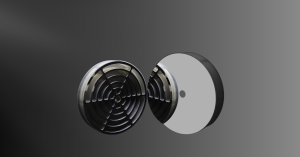
The original design’s thin ribs and deep pockets achieved greater mass reduction (0.61× the optimized design) but introduced higher deformation risk and lower manufacturability.
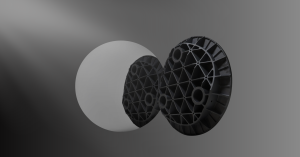
The optimized geometry by Avantier provides improved stiffness, reduced thermal distortion, and more reliable machining.
Overall, the optimized design offers a better engineering balance than the more aggressively lightweighted original.
Project Overview
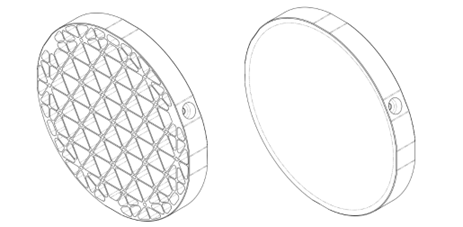
The project required designing a lightweight near-infrared (NIR) reflective mirror with a machined backside pocket structure. The goal was to reduce mass while preserving structural rigidity, thermal stability, and manufacturability.
Design Comparison
Two design concepts were evaluated via structural and thermal simulation:
Parameter
Customer’s Original Design
Optimized Design
Remaining Rib Thickness
Very thin rib structure
Thicker, more robust rib structure
Pocket Depth
Deep pocket geometry
Moderately reduced pocket depth
Relative Weight
0.61× of optimized design
Baseline
The customer’s design achieves a more aggressive mass reduction due to thinner ribs and deeper pockets. However, simulation results show that weight alone is not a sufficient metric for determining design quality.
Example optical design demonstrating how the reflective mirror interacts with the NIR imaging path and associated system tolerances
Engineering Assessment
1. Structural Rigidity and Mechanical Response
The 3 mm ribs in the original concept exhibit significantly higher deflection and stress concentration under typical mounting and operational loads.
The optimized 6 mm rib structure distributes stress more evenly, reducing risk of fracture and improving modal stiffness—critical for optical stability.
2. Thermal Stability
Deep pockets (38 mm) introduce larger temperature gradients and increase sensitivity to thermal bowing.
The reduced pocket depth (31.5 mm) in the optimized design lowers thermal deformation, improving optical surface stability in both high- and low-temperature cycles.
The optimized rib geometry improves tool accessibility, reduces vibration during machining, and provides consistent dimensional accuracy.
4. Operational Reliability
Combined structural and thermal analyses indicate the original design approaches critical limits in fatigue and deformation.
The optimized configuration provides a more robust safety margin, enabling long-term reliability without significant mass penalty.
Conclusion
Although the customer’s original design achieves greater weight reduction (0.61× of the optimized design), engineering evaluation shows that lightweighting must balance multiple factors—not just mass. Considering manufacturability, structural integrity, thermal behavior, and operational reliability, the optimized design delivers a more stable and production-ready solution while still achieving meaningful weight reduction.