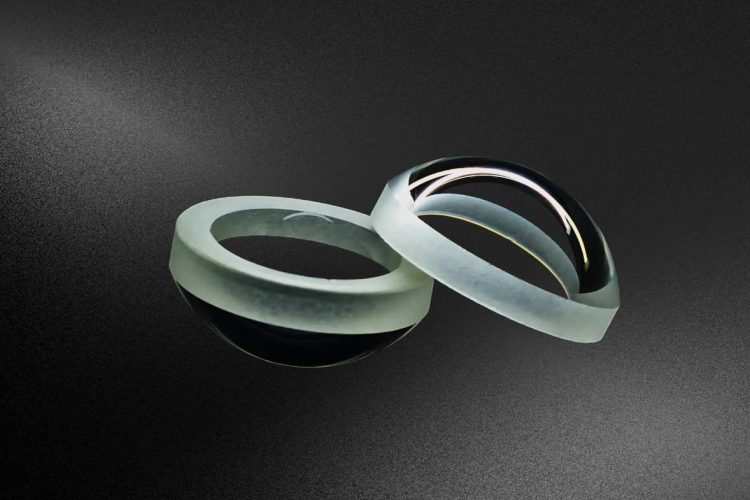
Optics for Micron-Scale Resolution & Low-Noise OCT
Optics for Micron-Scale Resolution & Low-Noise OCT, biomedical, life science, OCT

Key Takeaways Optical Coherence Tomography (OCT) relies fundamentally on High-Precision Optics for its unparalleled imaging capabilities.  Key OCT System Optical Components, like OCT Scan Lenses, OCT Beam Splitters, and OCT Collimators, must meet strict tolerances for wavefront quality and dispersion.  Achieving superior image contrast and resolution hinges on minimizing aberrations.  Manufacturing these components presents challenges […]

Read more
Surface Roughness Control in High-Precision Optics

 Key Takeaways: Surface roughness, surface texture, surface finish, surface roughness measurement, profilometer, Ra value, Rq roughness, and high-precision optics are essential for controlling optical performance. Nanometer-scale roughness causes light scattering, distortion, and lowers laser damage thresholds. Surface roughness results from manufacturing methods, material structure, and environmental effects. Tools like profilometers and AFM provide accurate surface […]

Read more
Durable Optical Materials: Selection Guide for Space & High-Temperature Lens Systems
Durable Optical Materials for Harsh Environments

Key Takeaways: The integrity of any optical system designed for space, defense, or high-energy applications hinges entirely on selecting the right durable optical materials. For engineers in telescope manufacturing and satellite payload design, the challenge is twofold: achieving dimensional stability using thermally stable substrates against extreme thermal cycling, and maintaining clarity via radiation-hardened coatings under […]

Read more
How Does Diffuse Optical Tomography Work?

Key Takeaways Diffuse Optical Tomography (DOT) is a non-invasive imaging technique using near-infrared light to visualize optical properties of soft tissue, such as brain or breast tissue.  By analyzing light absorption and scattering due to chromophores like hemoglobin, DOT enables real-time imaging of tissue oxygenation and composition.  Techniques include time, frequency, and steady-state domain systems.  […]

Read more
Miniaturized Optics for Small Satellites & CubeSats

Key Takeaways: Miniaturized optics for small satellites are enabling high-resolution imaging, agile beam steering, and real-time spectral sensing in compact CubeSat optical payloads. Innovations in miniaturized satellite optics—including compact satellite telescopes, MEMS mirrors, and CubeSat spectrometers—deliver advanced performance within strict mass, volume, and power limits. Engineers overcome challenges such as vibration, thermal shifts, and radiation […]

Read more
Deep Space Optical Communications

Key Takeaways Deep space optical communication (DSOC) uses laser-based systems for high-bandwidth, interplanetary data transfer.  NASA’s DSOC project achieved a 266 Mbps downlink from 19 million miles using photon-efficient modulation and precision optics.  The system includes a dual-wavelength flight transceiver, ground-based multi-laser uplink, and photon-counting receiver at Palomar Observatory.  Key challenges include beam stability, extreme […]

Read more
Case Study: Eye Lesion Detection Medical Lens
eye lesion detection lens, Lesion Detection Lens, detection lenses, medical lens, medical lenses

Discover how Avantier designed long- and zero- distance eye lesion detection lenses for infants and other patients; Optical designers had to consider precision, patient comfortability and helping to innovate future diagnosis techniques.

Read more