

Key Takeaways
- When LWIR requirements exceed market offerings, a custom optical design becomes essential—not optional.
- Early engineering validation prevents wasted time on unsuitable COTS or reverse engineering paths.
- A clean-sheet, performance-driven approach enables optimization for large image formats and fast apertures while maintaining cost targets.
- Integrating design for manufacturability (DFM) from the start ensures scalability and repeat production. Finally, a structured development process—from specification alignment to validation—accelerates decision-making and reduces internal delays, helping teams move efficiently from concept to production.
Customer Overview
- Industry: Infrared imaging and sensing (LWIR optics)
- Application: Defense, thermal imaging, advanced sensing systems
This customer operates in a highly specialized segment of infrared imaging, where off-the-shelf components rarely meet performance expectations. Their systems demanded a combination of precision optics, scalability, and cost control—requirements that quickly ruled out conventional solutions.
The Challenge
From the outset, the project presented a set of tightly coupled technical and commercial challenges:- No Viable COTS (commercial off-the-shelf solution ) Option The customer required a 40mm focal length, F/1.0 LWIR lens with a large image plane (~16.85–17mm)—a combination not available in standard market offerings.
- Highly Demanding Optical Specifications
- Large image format beyond typical LWIR designs
- Fast aperture (F/1.0) requiring precise aberration control
- High performance across the LWIR spectrum
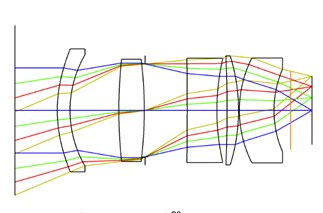
- Unclear Technical Direction Initially, the customer considered reverse engineering an obsolete lens, but this approach risked inheriting outdated limitations rather than achieving optimal performance.
- Cost vs Performance Tension
- Concern over NRE (Non-Recurring Engineering) costs
- Need to balance optical performance with manufacturability
- Scaling and Process Uncertainty
- No fixed order volume, but expectation of ongoing production
- Internal delays and lack of a structured development roadmap
Our Approach
We quickly reframed the problem—from sourcing a product to engineering a solution.
Early Gap Identification
We immediately confirmed that no COTS solution could meet the requirements, allowing the team to avoid wasted time and pivot toward a custom path.
Two Strategic Pathways Offered
- Reverse Engineering: Available if replication was required
- Clean-Sheet Design (Recommended): Optimized from first principles based on performance goals
Engineering-Led Consultation
Our optical engineers evaluated feasibility across key dimensions:
- Large image diameter handling
- LWIR material selection and transmission efficiency
- Aperture-performance trade-offs
Rather than forcing a legacy design, we introduced flexibility in specifications, enabling better optimization.
The Solution
Custom LWIR Optical Design (Clean-Sheet Approach)
We guided the customer toward a performance-driven optical architecture, specifically engineered for their application.
Key Elements of the Solution:
- Optimized Optical Design
Tailored for large-format LWIR imaging with F/1.0 aperture - Design for Manufacturability (DFM)
Integrated early to ensure scalability and cost control - Cost-Performance Balance
Engineered to meet target pricing at volume without compromising critical performance - Structured Development Process
A clear roadmap was established:- Specification alignment
- NRE kickoff
- Optical design phase
- Proposal delivery (~2 weeks)
- Validation and iteration
- Transition to production
Results & Impact
Clarity and Direction Restored
The customer moved from uncertainty to a well-defined technical and commercial path.
Faster Decision-Making
A structured process eliminated internal delays and aligned stakeholders.
Future-Proof Design
Instead of replicating an obsolete lens, the customer gained a modern, optimized solution.
Scalable Partnership
We positioned ourselves not just as a vendor, but as a long-term manufacturing and engineering partner for repeat orders.
Why This Matters for Optical Engineers & Procurement Teams
This case highlights a common reality in advanced IR imaging:- Standard products often don’t meet cutting-edge requirements
- Reverse engineering is rarely the optimal long-term solution
- The right partner can bridge engineering complexity and cost constraints
GREAT ARTICLE!
Share this article to gain insights from your connections!