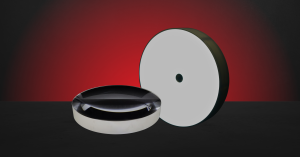
Case Study: Development of a Meter-Class Lightweight RB-SiC Primary Mirror
Key Takeaways
Developed a lightweight meter-class primary mirror with ultra-low surface density and more than 85% mass reduction.
Leveraged Reaction-Bonded Silicon Carbide (RB-SiC) to achieve high stiffness and excellent thermal stability.
Applied advanced structural optimization and lightweight cellular design to maintain nanometer-level surface stability.
Demonstrated a scalable manufacturing approach suitable for large-aperture optical systems.
Introduction
In the rapidly evolving sectors of Earth observation, astronomical research, and deep-space exploration, the demand for high-resolution imaging systems has reached an unprecedented peak. Central to these systems is the primary mirror, whose performance—determined by aperture size, surface accuracy, and mass—directly dictates the quality of mission-critical data.
At Avantier, we are redefining the limits of space-based optical systems. Our latest project involved the development of a meter-class RB-SiC primary mirror with a surface density of approximately 45 kg/m² and a lightweight ratio exceeding 90%.
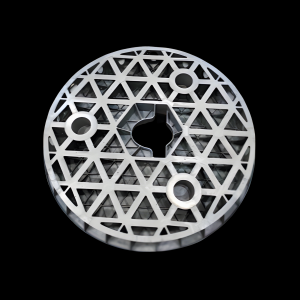
Mirror blank
The Imperative for Lightweight Mirrors
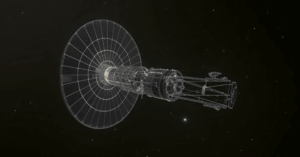
The pursuit of larger apertures has historically been constrained by launch vehicle capacity and structural rigidity. Traditional mirrors made from ULE glass or Zerodur often exhibit surface densities exceeding 70 kg/m², leading to prohibitive launch costs and overly complex support architectures.Modern benchmarks like the James Webb Space Telescope (JWST) and the Herschel Space Observatory have proven the necessity of lightweighting:
Avantier builds upon these foundations, delivering mirrors optimized for extreme stiffness, thermal stability, and rapid manufacturability.
Material Excellence: Why RB-SiC?
Selecting the optimal substrate is critical to balancing mass and thermal performance. We utilized Reaction-Bonded Silicon Carbide (RB-SiC) for its superior mechanical and thermal properties.
Comparative Material Properties
RB-SiC
Beryllium
ULE Glass
Zerodur
Density (kg/m³)
3050
1850
2210
2530
Elastic Modulus (GPa)
340
287
67
91
Specific Stiffness (E/ρ)
111.5
155
30.3
36
Thermal Conductivity (W/(m·K))
155
216
1.31
1.64
Thermal Expansion (10⁻⁶/K)
2.50
11.4
0.03
0.05
RB-SiC offers the ideal synergy of high specific stiffness to minimize gravitational sag and superior thermal stability to maintain optical integrity across the extreme temperature gradients of space.
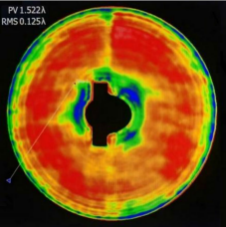
interferogram
Innovative Structural Design
Our meter class mirror utilizes a semi-closed back structure with a triangular cell pattern, refined via advanced structural analysis and optimization.
Rib Layout Optimization: Main ribs connect the faceplate to the backplate for core support, while optimized auxiliary rib structures enhance local stiffness to prevent “print-through” effects during the polishing phase.
Distributed Reference Surfaces: We implemented distributed reference points on the mirror’s periphery. Distributed reference surfaces significantly reduced machining requirements and improved manufacturing efficiency.
Off-Axis Central Aperture: The central aperture is custom-shaped to maximize clear aperture and optical throughput, specifically tailored to minimize system obscuration.
Advanced Manufacturing & Optimization
We utilize a combination of gel-casting and reaction sintering to produce near-net-shape mirror blanks. This enables complex internal geometries that are impossible to achieve via traditional subtractive machining.
To reach the final design, we employed Parametric Finite Element Modeling and a multi-objective genetic algorithm to fine-tune structural parameters:
Representative Structural Features
Parameter
Representative Design
Faceplate Thickness
Optimized for stiffness and weight
Rib Structure
Lightweight triangular-cell architecture
Mirror Configuration
Semi-closed back structure
Verified Performance Metrics:
Surface Density: 40–50 kg/m²
Gravitational Deformation (Horizontal): a few nanometers RMS
First Natural Frequency: > 500 Hz
Polishing-Induced Deformation: < 50 nm PV
Conclusion: Paving the Way for the Next Frontier
The successful development of the meter class RB-SiC mirror represents a paradigm shift in spaceborne optical engineering. By harmonizing advanced material science with genetic algorithm-driven design, Avantier has demonstrated that high-resolution performance no longer requires prohibitive mass. This scalable architecture proven for meter-class optical systems provides a viable roadmap for apertures exceeding 2 meters, directly supporting future missions like LUVOIR and HabEx. As we look toward the next generation of Earth observation and deep-space discovery, our ultra-lightweight mirrors will serve as the essential eyes of humanity, offering clearer views of our universe with unprecedented efficiency and precision.