

Key Takeaways
- Role in Optical Manufacturing: Optical polishing ensures high surface accuracy, low roughness, and minimal damage, leading to superior light behavior.
- Precision Polishing Methods: Techniques such as CCOS, IBF, MRF, Reactive Plasma Polishing, and Precision Diamond Cutting address advanced precision demands.
- Applications: Precision polishing techniques support diverse geometries, hard materials, and high-performance systems, including telescopes and lithography tools.
- Challenges: High costs, technical expertise, and inefficiencies in large-scale polishing remain significant obstacles.
- Future Impact: Advancements in optical polishing will drive innovation and elevate optical manufacturing performance.
The Role of Polishing in Optical Lens Manufacturing
Transforming raw optical materials into precision components requires an exact sequencing of production phases: blank forming, rough grinding, fine grinding, precision polishing, and thin-film coating. Among these stages, optical lens polishing is the definitive step that dictates a component’s final surface quality and performance.
High-quality optical components require three distinct characteristics: high surface accuracy, sub-nanometer surface roughness, and minimal subsurface damage. The quality achieved during the optical polishing phase directly controls downstream light behavior:
- Surface Accuracy: Minimizes optical wavefront distortion and beam deviation.
- Surface Roughness: Eliminates light scattering to maximize total throughput and contrast.
The Evolution of Optical Polishing Methods
Traditional optical lens polishing relies on mechanical friction and chemical erosion using slurry and polyurethane pads. While effective for flat and spherical components, traditional methods struggle with the complex geometries—such as aspherical and freeform surfaces—required by modern high-performance systems.
To meet the sub-nanometer tolerances of aerospace, semiconductor, and medical applications, optical manufacturing has evolved toward advanced, automated precision technologies. These modern methods ensure highly repeatable, deterministic material removal across specialized materials.
5 Advanced Precision Optical Polishing Methods
1. Computer-Controlled Optical Surfacing (CCOS)
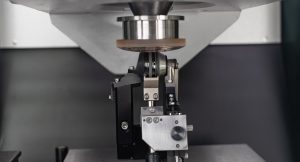
Computer-Controlled Optical Surfacing (CCOS) uses numerically controlled polishing tools to achieve high precision. This modern contact polishing technique relies on computer algorithms to model the surface and guide the movement, speed, pressure, and dwell time of polishing heads. By incrementally removing material, CCOS reduces errors and achieves the desired surface accuracy.
CCOS has been instrumental in fabricating high-precision components such as the Hubble Telescope’s primary mirror and the Extremely Large Telescope (ELT).
Advantages | Limitations |
Suitable for diverse geometries, including aspherical and freeform surfaces. | Low efficiency for polishing large-diameter components due to small tool heads. |
Allows localized adjustments for regional errors. | Requires skilled programming and operation |
Widely used for producing components like aspherical lenses. |
2. Ion Beam Figuring (IBF)
Ion Beam Figuring is a non-contact polishing method where an ion beam removes material at an atomic level. The interaction between ions and material atoms ensures precise shape correction and surface refinement.
IBF is particularly useful in aerospace optics, where lightweight and rigid components are crucial.
Advantages | Limitations |
High precision with minimal surface damage or internal stress. | Low material removal rate. |
Effective for hard materials like silicon (Si) and silicon carbide (SiC). | |
Ideal for applications requiring atomically smooth and polished surfaces, such as extreme ultraviolet lithography systems. |
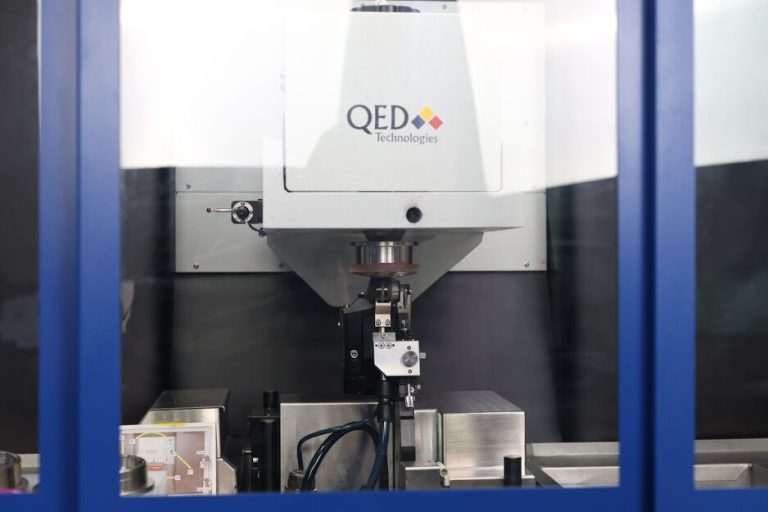
3. Magnetorheological Finishing (MRF)
Magnetorheological Finishing uses a fluid with variable viscosity under a magnetic field. This fluid, containing abrasive particles, forms a controlled polishing interface for micro- and nano-level material removal.
MRF is widely used for polishing spherical lenses, aspherical lenses, prisms, and freeform surfaces.
Advantages | Limitations |
High precision with no subsurface damage. | High equipment and maintenance costs. |
Suitable for complex geometries, such as freeform surfaces. | Inefficient for large-scale rough polishing. |
Adjustable hardness of the polishing interface. |
4. Reactive Plasma Polishing
Reactive Plasma Polishing employs chemical etching in a vacuum chamber to achieve ultra-smooth surfaces. Plasma and reactive gases remove material at the atomic level, making this a non-contact polishing method.
This technique is often used for the final finishing of high-precision components.
Advantages | Limitations |
High material removal efficiency with sub-nanometer surface roughness. | High equipment costs and technical expertise requirements. |
Ideal for large-aperture, high-hardness, and brittle materials.Pollution-free and damage-free |
5. Precision Diamond Cutting
Precision Diamond Cutting uses ultra-precision lathes and diamond tools to directly cut optical surfaces. Diamond’s hardness and thermal resistance ensure smooth, mirror-like optical finishes.
Common uses include laser mirrors, parabolic mirrors, and infrared lenses.
Advantages | Limitations |
Rapid processing with sub-micron accuracy. | Potential for microscopic scratches, requiring post-processing for higher quality finishes. |
High-quality surfaces suitable for immediate use in some cases. | Limited suitability for specific surface geometries. |
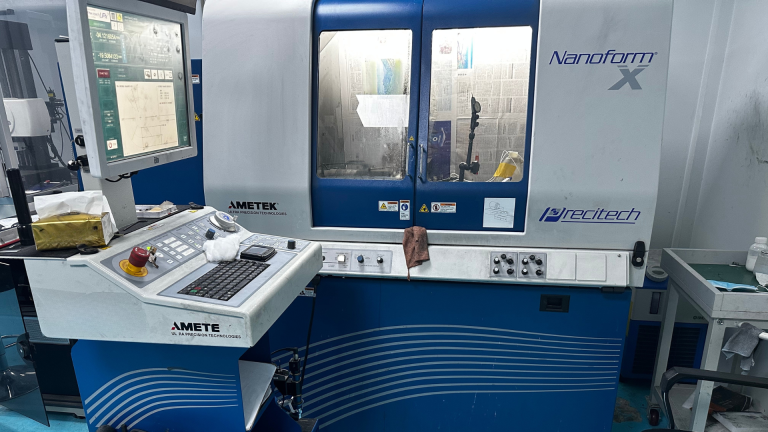
Sourcing Precision Optical Polishing Services
Selecting the ideal manufacturing workflow requires balancing material hardness, geometric complexity, and production budgets. Whether your application requires standard optical lens polishing for high-volume consumer optics or deterministic finishing (MRF/IBF) for aerospace applications, selecting a specialized manufacturing partner ensures long-term system reliability.
To review our complete custom component capabilities or to submit an RFQ for your specific substrate requirements, visit our dedicated optical lens assembly manufacturing center.



GREAT ARTICLE!
Share this article to gain insights from your connections!
