

Key Takeaways
- DUI NMF-1000 represents a dynamic differential confocal approach optimized for freeform optical measurement with high local slope adaptability (±20°).
- Taylor Hobson LUPHOScan 850 HD uses multi-wavelength interferometry for large aperture optical metrology, supporting diameters up to 850 mm and millimeter-scale absolute height measurement.
- The architectural difference is physics-driven: local high-bandwidth slope tracking vs. global absolute interferometric ranging.
- System selection should be based on geometry, spatial frequency content, slope distribution, and environmental stability requirements—not brand preference.
Physics-Driven Selection of a 3D Optical Surface Profiler
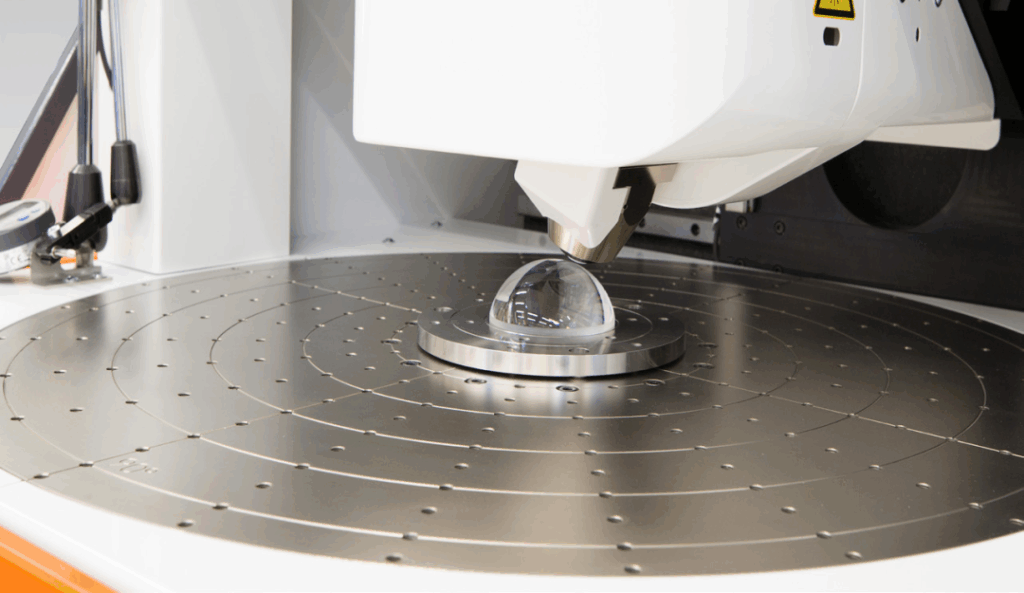
In high-precision optics, the challenge has shifted from raw resolution to matching measurement architecture with surface geometry. Whether utilizing differential confocal slope tracking or multi-wavelength interferometry, the selection must be driven by physics—not brand. This analysis explores the architectural trade-offs between the DUI NMF-1000 and Taylor Hobson LUPHOScan 850 HD to ensure metrology integrity across complex freeforms and large apertures.
1. Geometry as the Primary Constraint in Modern Optical Metrology
Advanced optical systems increasingly combine:- Off-axis freeform surfaces
- Large-aperture rotationally symmetric optics
- Mid-spatial-frequency (MSF) control requirements
- Sub-nanometer surface tolerances
2. Measurement Physics Comparison
2.1 Differential Confocal Microscopy — Architecture of the DUI NMF-1000
Differential confocal systems rely on the axial intensity gradient around focus:
![[S(z) = I_1(z) - I_2(z)], Freeform optical surface profiler, Freeform Optical Measurement, differential confocal vs interferometry, large aperture optical metrology, differential confocal microscopy](https://avantierinc.com/wp-content/uploads/2026/03/image2.png)
Within the linear response region:
![[S(z) = I_1(z) - I_2(z)], Freeform optical surface profiler, Freeform Optical Measurement, differential confocal vs interferometry, large aperture optical metrology, differential confocal microscopy, [\frac{dS}{dz} \rightarrow \text{axial sensitivity}]](https://avantierinc.com/wp-content/uploads/2026/03/image5.png)
- No phase ambiguity (unlike interferometry)
- Short coherence length → reduced retrace error
- High axial sensitivity in the nanometer regime
- Dynamic slope tracking enabled by low-mass (~50 g) probe
![[\theta_{max} \approx \sin^{-1}(\text{NA}_{eff})], Freeform optical surface profiler, Freeform Optical Measurement, differential confocal vs interferometry, large aperture optical metrology, differential confocal microscopy](https://avantierinc.com/wp-content/uploads/2026/03/image4.png)
- Reduced overlap of illumination/detection cones
- Defocus asymmetry
- Collection efficiency drop
2.2 Multi-Wavelength Interferometry — Architecture of the LUPHOScan 850 HD
The LUPHOScan 850 HD extends unambiguous measurement range using synthetic wavelength interferometry:
![[\lambda_s = \frac{\lambda_1 \lambda_2}{|\lambda_1 - \lambda_2|}], Freeform optical surface profiler, Freeform Optical Measurement, differential confocal vs interferometry, large aperture optical metrology, differential confocal microscopy](https://avantierinc.com/wp-content/uploads/2026/03/image6.png)
- Absolute millimeter-scale height measurement
- No need for mechanical range stitching
- High radial slope handling (approaching grazing angles)
- Fringe contrast reduction
- Angular coherence loss
- Speckle decorrelation
- Reduced interferometric overlap
- Air refractive index fluctuations
- Vibration
- Long optical path instability
3. Error Budget Perspective (Research-Relevant Comparison)
For experienced optical engineers, repeatability and accuracy must be contextualized.
Error Mechanism | Differential Confocal | Multi-Wavelength Interferometry |
Phase ambiguity | None | Limited by synthetic wavelength |
Retrace error | Minimal | Present |
Abbe offset | Low (coaxial probe) | Stage alignment dependent |
Cosine error | Probe tilt dependent | Stage tilt dependent |
Speckle noise | Low | Moderate–High |
Environmental sensitivity | Moderate | High |
Slope-induced signal loss | NA limited | Fringe contrast limited |
When discussing “sub-nanometer repeatability,” critical qualifiers include:
- Spatial bandwidth (low vs MSF)
- Averaging time
- Environmental class (temperature and air stability)
- Lateral sampling pitch
Confocal systems typically excel in short-term repeatability over limited apertures.
Interferometric systems excel in global absolute form accuracy over large apertures.
4. Spatial Frequency Domain Considerations
Surface error exists across spatial frequencies:- Low-frequency form error
- Mid-spatial frequency ripple
- High-frequency roughness
- Tool path artifacts
- Local curvature transitions
- Asymmetric slope gradients
- Strong MSF sensitivity
- Limited by scanning pitch and servo bandwidth
- Less dependent on global coherence
- Gravity sag compensation
- Long-period figure error
- Thermal drift
5. Industrial Constraints Beyond Optics
For optics up to 850 mm diameter and 350 kg mass:- Stage straightness
- Structural stiffness
- Thermal expansion
- Air turbulence over long cavities
- Probe servo bandwidth
- Real-time slope compensation
- Dynamic tracking stability
6. Decision Framework for Advanced Users
Dominant Constraint |
Preferred Architecture |
High local slope, asymmetric geometry |
Differential confocal (DUI NMF-1000) |
Large diameter, absolute form control |
Multi-wavelength interferometry (LUPHOScan 850 HD) |
Rough or ground surface measurement |
Interferometric system |
MSF-sensitive precision freeform |
Confocal system |
Industrial-scale rotational optics |
Interferometric system |
7. Emerging Hybrid Directions
Future 3D optical surface profiler systems will likely integrate:- Absolute interferometric referencing
- Local dynamic confocal slope tracking
- AI-based path planning and error compensation
- Environmental adaptive correction
Conclusion: Strategic Metrology for Optical Integrity
The distinction between freeform and large-aperture metrology is fundamentally architectural: differential confocal systems prioritize local adaptability via high-bandwidth slope tracking, while multi-wavelength interferometry excels in absolute range and global form accuracy. Understanding these physics-driven limits—such as NA-based slope constraints versus fringe-contrast degradation—is essential to eliminating measurement artifacts. At Avantier, we prioritize this selection to ensure that spatial frequency control and form accuracy are strictly aligned with design intent, providing verifiable certainty for every optical component we deliver.
To understand the design evolution and market trends driving these requirements, explore our comprehensive overview of the latest [Developments in Freeform Optics].
GREAT ARTICLE!
Share this article to gain insights from your connections!