

KeyTakeaways
- Finite conjugate microscope objectives provide compact, stable, and cost-effective high-resolution imaging for industrial inspection, micro-nano machining, and portable diagnostic systems.
- Their fixed-distance design delivers excellent NA, precise aberration control, and reliable performance across UV, visible, and IR applications.
- While less flexible than infinity-corrected systems, finite conjugate objectives excel in integrated OEM instruments and space-constrained environments where optical simplicity, durability, and imaging precision are critical.
Achieving high-resolution imaging in environments with limited space, tight budgets, or integrated optical constraints is a major challenge. Finite distance (finite conjugate) microscope objectives—a long-established but highly capable optical architecture—remain one of the most efficient solutions.
Rather than competing with infinity-corrected systems, finite conjugate objectives excel in applications requiring compactness, stability, and cost-effective excellence, making them indispensable in industrial inspection, portable diagnostics, and micro-nano machining.
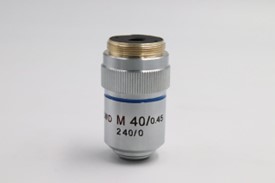
1. Understanding Finite Conjugation: How It Differs from Infinity-Corrected Systems
In optical design, conjugation refers to the point-to-point mapping between an object plane and its corresponding image plane.Infinite Conjugate Objectives
- Project the specimen to optical infinity, producing a parallel light path.
- Require a separate tube lens to form the final image.
- Allow filters, beam splitters, and modulators to be inserted into the parallel beam without degrading imaging performance.
- Offer versatility but at the cost of higher system complexity and expense.
Finite Conjugate Objectives
- Form a real image directly behind the objective at a fixed distance (commonly 160 mm for DIN systems).
- The single-stage imaging design creates:
- Shorter optical paths
- Higher rigidity and stability
- More compact and cost-efficient systems
- Widely used in integrated instruments and industrial systems where mechanical simplicity matters.
2. Operating Principle and Key Optical Performance Parameters
A finite-conjugate objective operates through a fixed optical workflow: light collection → aberration correction → real image formation The objective gathers light via the front group, corrects aberrations using a precisely engineered lens assembly, and forms a stable intermediate image at the end of the mechanical tube length.Four Core Parameters Define Finite-Conjugate Performance
2.1 Numerical Aperture (NA): The Basis of Resolution
- Determines light-gathering ability and theoretical resolving power.
- Oil immersion finite objectives can exceed NA 1.4, reaching the limits of classical optical microscopy.
2.2 Resolution: Revealing Micro- and Nano-Scale Detail
Derived from Abbe’s diffraction limit: High-NA finite objectives combined with short-wavelength illumination (e.g., UV) offer sub-micron resolution, allowing visualization of organelles, fine surface textures, and micro-fabricated structures.2.3 Aberration Correction
Finite objectives range from:- Achromats (basic color correction)
- Plan-achromats (flat-field correction)
- Advanced multi-element apochromats
- Low chromatic aberration
- Reduced field curvature
- High image uniformity
2.4 Working Distance (WD): Application Flexibility
Working distance varies dramatically:- ~10–30 mm for low magnification (4×, 10×)
- <0.1 mm for high-magnification oil-immersion lenses
- In-vivo sample manipulation
- Machine vision inspection
- Laser processing and micro-machining
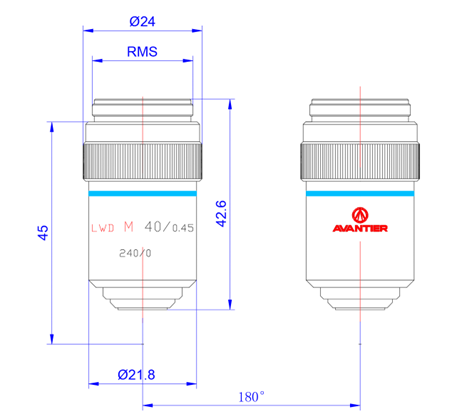
3. Optical and Mechanical Design Philosophy: Precision Under Constraints
Finite-conjugate objectives achieve performance through careful balancing of optical design, mechanical rigidity, and cost optimization.
3.1 Optical Structure Engineering
Low-magnification lenses (4×, 10×):
- Use 2–3 cemented groups
- Correct spherical and chromatic aberrations
- Prioritize long working distance and wide fields of view
Medium magnification (20×, 40×):
- Add additional elements and special shapes (e.g., crescent lenses)
- Improve NA and enhance aberration control
High-magnification oil immersion (100×):
- Most complex, typically 6–8 lens elements
- Symmetric or semi-symmetric arrangements
- Designed for extreme NA and minimal aberration
Reflective Finite Telephoto Designs
For UV/IR work (200–11,000 nm), reflective objectives eliminate glass-based chromatic dispersion using:- Concave/convex mirror combinations
- Broadband performance across wide spectral ranges
3.2 Mechanical Structure: Rigid, Stable, and Calibration-Free
Key characteristics:- Precision-machined metal barrels
- Standardized RMS threads for universal compatibility
- Coaxial alignment ensured by tight positioning surfaces
- Lenses held by compression rings or bonded assemblies
- Vibration
- Thermal drift
- Shock
Manufacturing Advantage
Finite objectives are simpler than infinity-corrected objectives:- No need to account for downstream optics in a parallel beam
- Looser tolerance stacking
- Lower overall production cost
- Educational microscopes
- Budget-conscious scientific tools
- Integrated OEM systems
3.3 Technical Limitations
Despite their strengths, finite-conjugate systems have known constraints:1. Fixed Optical Path
Adding filters, beam splitters, or optical modules shifts the image plane, causing:- Defocus
- Aberrations
- Magnification errors
2. No Flexible Magnification
Infinity systems adjust magnification via tube lens focal length; finite systems cannot.
3. Limited Use in Advanced Modalities
Not ideal for:- Confocal microscopy
- Fluorescence lifetime imaging
- Complex laser-based optical paths
4. Application Areas: Where Finite-Conjugate Objectives Excel
Finite-conjugate microscope objectives play an important role across industry, research, and micro-fabrication.
4.1 Industrial Inspection & Machine Vision
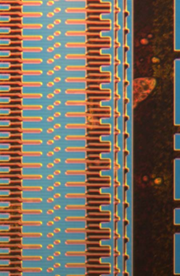
Used for:- PCB inspection
- Semiconductor quality control
- Medical device evaluation
- Compact imaging modules
- High resolution
- Low cost
- Stable, vibration-resistant imaging
4.2 Life Science Imaging & Portable Diagnostics
Finite objectives enable:- Portable fluorescence microscopes
- Field-deployable diagnostic devices
- Point-of-care analyzers
- Lightweight
- Low power consumption
- Durable
- High clarity without bulky optics
4.3 Micro-Nano Machining & Laser Processing
In femtosecond and ultrafast laser applications, objectives must focus beams to diffraction-limited spots. Finite objectives offer:- High NA for tight focus
- Excellent aberration control
- Reliable energy delivery
- Glass engraving
- Precision cutting
- Micro-structuring of semiconductor materials
4.4 UV & IR Broadband Imaging
Reflective finite objectives support wavelengths from 200 nm to 11,000 nm, making them ideal for:- FTIR systems
- UV lithography
- Deep-UV spectroscopy
- IR material characterization
5. Conclusion
Finite distance conjugate microscope objectives remain foundational elements of modern optical engineering. Their unmatched combination of:- Compact structure
- High imaging performance
- Mechanical stability
- Cost efficiency
Related Content





GREAT ARTICLE!
Share this article to gain insights from your connections!