

Key Takeaways:
- Indirect ophthalmoscopes use a high‑diopter double convex lens as a front lens to create an enlarged inverted real image of the fundus for detailed retinal assessment.
- High‑order aspheric design on one surface of the double convex lens corrects higher‑order aberrations, enhancing image contrast and reducing distortion compared to a purely spherical lens.
- A 40D front lens provides carefully chosen magnification and field of view, supporting efficient eye examinations across a range of patients.
- Precision CNC aspheric machining and tight surface‑figure control (PV < 0.5 µm, eccentricity < 1 arcmin) are critical to maintain imaging performance in clinical use.
- Vis‑NIR broadband antireflection (AR) coatings on the double convex lens minimize reflection losses and support both visible and infrared illumination modes during diagnosis.
Case Study: Double Convex Lens for Indirect Ophthalmoscopes
This case study details the design and manufacturing of a custom double convex lens used as the front lens in an indirect ophthalmoscope, a key instrument for high‑quality fundus examinations. By combining a biconvex geometry with a high‑order aspheric surface, Avantier’s double convex lenses correct higher‑order aberrations, improve image sharpness, and expand the usable field of view for retinal imaging.
To learn more about our manufacturing limits, raw optical substrates, or to request custom optics engineering, explore our comprehensive biconvex lens and double convex lenses design capabilities.
Role of the Biconvex Lens in Indirect Ophthalmoscopy
In clinical ophthalmic imaging, a double convex lens serves as a high-diopter converging optics component. Positioned directly in front of the patient’s eye, the lens intercepts light scattering back from the fundus to project an enlarged, inverted real image in space.
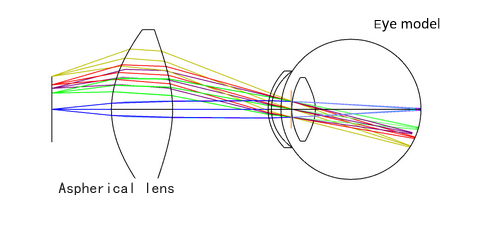
While standard spherical biconvex optics frequently introduce peripheral blurring at high powers, this medical application utilizes a customized 40-diopter high-order aspheric profile. This geometry enables the system to maintain a short working distance and maximize the usable field of view required for diagnostic fundus exams.
Learn how this ophthalmic application fits into our broader Medical Optical Components & Lenses portfolio.
Optical Design: From Spherical Lens Limitations to High‑Order Aspherics
Why not a purely spherical convex lens?
In theory, a spherical double convex lens can form the required enlarged fundus image, but spherical aberration and other higher‑order aberrations degrade contrast and limit resolution, especially at high diopter values. This is unacceptable for indirect ophthalmoscopes, where subtle lesions must be visible at the retinal periphery.
To address those limitations, Avantier’s design uses a single‑sided high‑order aspheric surface on the double convex lens. Compared to a traditional low‑order asphere, a high‑order aspheric surface introduces additional degrees of freedom in the sag equation, enabling more precise control of surface curvature and therefore better correction of higher‑order aberrations across the full field.
For a deeper dive into aspheric design principles, see our Complete Guide to Aspheric Lens.
Optical Configuration: 40D Aspheric Biconvex Lens
When moving beyond standard multi-lens configurations to a specialized single front lens application, the system relies on exact design thresholds:
- Diopter Power: 40D positive focal power to optimize real-image positioning between the patient and internal relay lens systems.
- Substrate Selection: Premium H-K9L optical glass, selected for its highly uniform transmission spectrum, exceptional homogeneity, and reliable manufacturability under CNC polishing protocols.
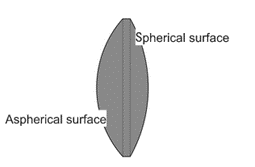
- Geometry Matrix: A specialized biconvex profile featuring a single-sided, high-order aspheric surface designed to resolve the spherical aberrations native to high-power lenses.
By utilizing standard positive imaging theory but integrating strict mechanical controls, the resulting ray path matches standard double convex lens principles while eliminating the field distortion common in off-the-shelf optics.
Specifications of Double Convex Lens
Front Lens Specifications (40D High‑Order Aspheric Double Convex Lens)
Diopter | 40D |
Material | H-K9L |
Shape | Convex lens, single-sided aspherical surface |
Diameter | 40mm |
Thickness | 15mm |
These parameters are chosen to balance magnification, field of view, working distance, and manufacturability in a clinical indirect ophthalmoscope.
Manufacturing Process and Surface‑Figure Control
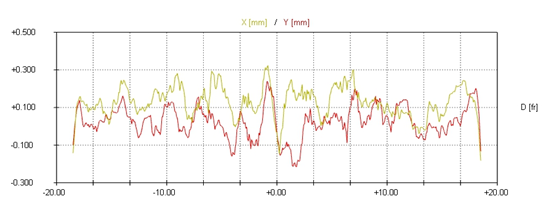
Achieving the required surface accuracy on a double convex lens with a steep aspheric surface is challenging, because small vertex curvature and rapid slope changes are highly sensitive to machining errors. In this case, the aspheric PV (peak‑to‑valley) surface error must be kept below 0.5 µm to avoid noticeable image blur and distortion in retinal images.
Avantier uses a multi‑step CNC aspheric manufacturing workflow:
- The spherical surface is machined first and used as the datum for subsequent clamping and alignment.
- The aspheric surface is then generated using CNC aspheric machining, with a re‑optimized polishing tool specifically designed for the convex aspheric profile.
- Surface accuracy and quality are monitored in‑process (online detection), enabling real‑time correction of form error before final polishing and edging.
- Final centering and edging ensure that lens eccentricity remains below 1 arcmin, minimizing coma and decenter‑induced aberrations in the assembled indirect ophthalmoscope.
This combination of CNC grinding, polishing, and metrology is typical of Avantier’s approach to high‑precision ophthalmic lenses and other medical imaging components.
Coatings and Broadband Imaging Performance
To maximize throughput and compatibility with different illumination modes, the double convex lens is coated with a Vis‑NIR broadband antireflection coating. This coating:
- Reduces surface reflections across the visible and near‑infrared bands.
- Improves contrast and SNR in fundus images under white‑light and NIR illumination.
- Minimizes ghosting and stray light that could mask subtle retinal features.
For related coating capabilities across other optics, explore Avantier’s work on custom optical coatings in our technical and application notes.
Conclusion: Benefits of a High‑Order Aspheric Double Convex Lens
The 40D high‑order aspheric double convex lens described in this case study demonstrates how careful optical design and precision manufacturing can substantially improve indirect ophthalmoscope performance. By moving beyond a simple spherical convex lens and adopting a high‑order aspheric biconvex configuration, the system:
- Corrects higher‑order aberrations and reduces distortion.
- Enhances image sharpness, especially at the retinal periphery.
- Maintains tight control of surface error (PV < 0.5 µm) and eccentricity (< 1 arcmin) for consistent clinical performance.
- Supports Vis–NIR operation, enabling flexible illumination strategies in modern fundus imaging.
Altogether, this double convex lens case illustrates how advanced lens design and manufacturing directly translate into more accurate and efficient ocular assessments, ultimately benefiting both clinicians and patients.
To discuss a custom double convex lens or other ophthalmic lens designs, contact Avantier or review our Aspheric Lens Case Studies for additional examples of high‑precision medical optics.
Related Content: