

Key Takeaways
- Automotive fixed-focal length lenses deliver stable, high-performance imaging essential for ADAS and autonomous driving.
- Their multi-element optical design ensures clarity in all-weather conditions, while optimized focal lengths support forward detection, blind spot monitoring, and long-range sensing.
- With radar-camera fusion, high-resolution CMOS sensors, and robust environmental durability, these lenses enable accurate 3D perception and real-time decision-making.
- Avantier manufactures custom fixed-focus length lenses tailored for automotive applications, providing reliable optical solutions that enhance safety, precision, and next-generation vehicle perception.
As autonomous driving continues advancing toward higher levels, stable and reliable perception remains the essential foundation of vehicle safety. Extreme conditions — dense fog, heavy rain, snow, glare, and nighttime backlighting — create “visual blind spots” for camera-only systems. To overcome these challenges, the industry is moving toward multi-sensor fusion, especially the integration of optical imaging with radar detection.
At the heart of this trend is the automotive fixed-focal length lens, a stable, cost-efficient, and high-performance optical solution enabling all-weather perception in ADAS and L1–L3 autonomous driving systems.
1. Why Fixed-Focal Length Lenses Lead Automotive Perception
Fixed-focus lenses offer a superior balance of performance, cost, and long-term reliability, making them the dominant choice for vehicle-mounted cameras.Synergistic Advantages
- Combines optical imaging with millimeter-wave radar for robust dual-mode sensing.
- Simpler and more reliable than zoom lenses, with lower mechanical complexity.
- Designed for consistent image quality, ideal for safety-critical applications.
Optimized for Real Driving Conditions
Fixed-focal lenses are tuned for specific application focal lengths, ensuring:- High perception accuracy
- Stability in harsh conditions (rain, fog, snow, dust)
- Consistent performance across temperature extremes
2. Technical Core: From Light Capture to 3D Perception
Automotive fixed-focus lenses operate through three key stages:1. Light Capture
Precision optics collect ambient light and radar-assisted reflections. Intelligent infrared filters eliminate noise to ensure clean input signals.2. Signal Conversion
Light is converted into electrical signals by a CMOS sensor, then optimized with ISP processing:- Noise reduction
- HDR enhancement
- Distortion correction
3. Data Fusion
Advanced algorithms deeply fuse high-definition camera images with radar-derived distance and velocity data to generate accurate environmental perception results. This fusion enables:- Accurate 3D Perception: The core breakthrough lies in overcoming the inherent limitation of a ‘single-lens without physical parallax’ through advanced algorithmic compensation, achieving precise mapping from the 2D image plane to 3D space.
- Enhanced Object Tracking
- Increased Reliability: This deep integration dramatically improves detection stability and reliability in complex environments (rain, fog, snow, dust).
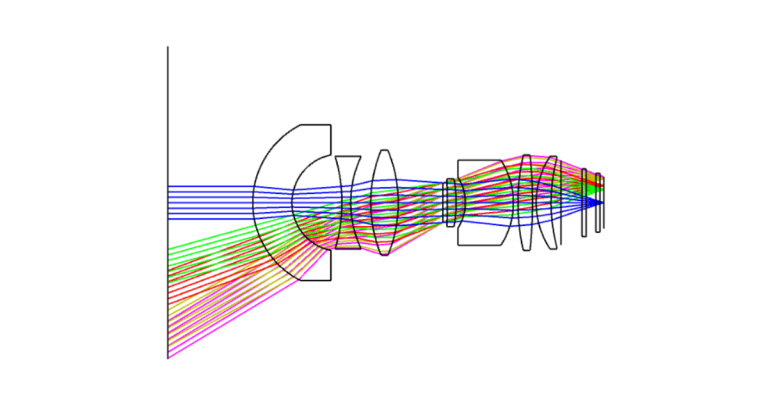
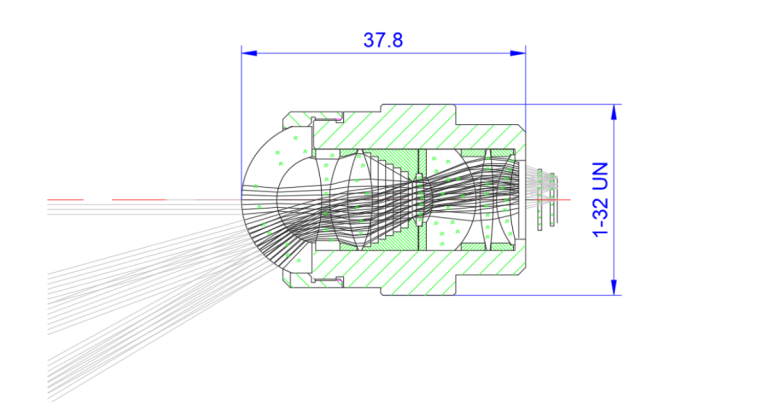
Product Specifications:
- Focal Length: 5.8 mm
- Operating Wavelength Range: 900–980 nm
- Field of View: 60°
- Dimensions: Ø25.4 mm × 37.8 mm
- Interface: 1-32 UN
3. Optical Design & Focal Length Options
Lens Architecture
Common automotive fixed-focus lenses use a five-element hybrid design:- Two negative lenses
- Three positive lenses
- Combination of spherical and aspherical elements
- High resolution
- Reduced aberration
- Optical length under 11.5 mm
Focal Length Options
Different use cases require different focal lengths:
Focal Length |
Application |
Range |
8–12 mm (short focus) |
Front-view, multi-lane detection across 8 lanes |
Up to 200 m |
20–25 mm (mid focus) |
Blind Spot Detection, side/rear view |
3-lane width |
50 mm (telephoto) |
High-speed long-distance detection |
Precision long-range |
Interfaces & Environmental Protection
- M16, C/CS-mount standards
- RS485 data support
- DC12V power
- IP67 waterproof/dustproof
- Operating temp: –40°C to +85°C
4. Key Technical Performance Metrics
Optical Performance
- Aperture: F1.3 for exceptional low-light capability
- FOV: 110° ultra-wide to 30° narrow telephoto
- Resolution: 4MP, 1/1.8-inch CMOS
- Recognizes >16 object features (plates, vehicle type, color)
Functional Capabilities
- Detection range up to 250 m with radar fusion
- Tracks up to 128 targets simultaneously
- <5% measurement error margin
- 30 Hz ToF response for real-time decision-making
Algorithm Integration
Fully compatible with:- ADAS perception algorithms
- Traffic and congestion detection
- Smart signal control system requirements
5. Application Scenarios for Automotive Fixed-Focus Lenses
ADAS Applications
- 12 mm: ACC, AEB, forward detection (0–200 m)
- 20–25 mm: Blind Spot Detection, lane-change assistance
- Detection of: pedestrians, cyclists, vehicles, lane markings
Advanced Level 3+ Applications
Automotive IR fixed-focus lenses support:- All-weather operation
- Rain/fog penetration
- Nighttime and low-visibility detection
6. Industry Trends & Market Outlook
Technology Trends
- Miniaturization: Optical path shrinking below 10 mm
- Multi-band Fusion: Visible + IR + millimeter wave compatibility
- High-Resolution Upgrade: 8MP sensors with F1.0–F1.3 apertures
Market Drivers
- Increasing adoption of L3 autonomous driving
- Rapid expansion of V2X and RSU infrastructure
- Stricter safety regulations and rising ADAS demand
Automotive Fixed-Focal Length Lenses for ADAS
The automotive fixed-focus lens is becoming the central optical component for ADAS and autonomous driving perception. Through the combination of:
- High-precision optical imaging
- Radar fusion
- High-resolution sensors
- Advanced algorithms
these lenses deliver stable, all-weather, long-range perception critical to next-generation mobility.
As the automotive industry evolves, fixed-focal length lenses will continue to push advancements in:
- Miniaturization
- Precision
- Environmental adaptability
Supporting the global transition toward safe, scalable autonomous driving.
Related Content



GREAT ARTICLE!
Share this article to gain insights from your connections!