Key Takeaways

  • Total Internal Reflection (TIR) occurs when light traveling through a high-index medium hits a boundary with a lower refractive-index medium at an angle exceeding the critical anglec = arcsin(n2/n1)). 
  • Engineering applications leverage TIR’s near-100% reflective efficiency for low-loss signal transmission in fiber optics, precision image rotation in prisms, and near-field sensing via evanescent waves. 
  • Mastery of TIR is essential for optimizing numerical aperture and minimizing parasitic losses in advanced photonic systems.

Total Internal Reflection (TIR) is more than a visual curiosity; it is a foundational principle in photonics and waveguide engineering. For engineers working in optical communications, sensor design, or imaging systems, mastering the boundary conditions that govern TIR is essential for optimizing signal integrity and optical efficiency.

1. The Physics of Boundary Conditions

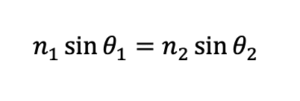
TIR occurs at the interface between two dielectric media when a light ray travels from a high-refractive-index medium (n1) toward a lower-index medium (n2). According to Snell’s Law:

n1sintheta1 n2sintheta

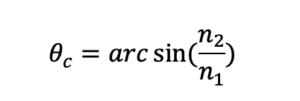
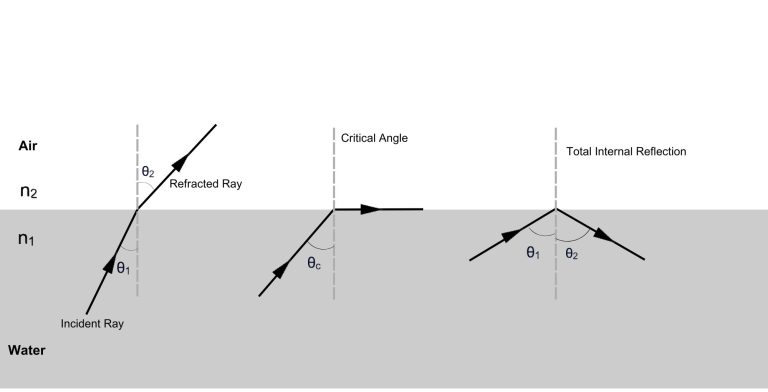
As the angle of incidence θ1 increases, the angle of refraction θ2 approaches 90°. The specific value of θ1 that results in θ2 = 90° is defined as the Critical Angle (θc):

thetac=arcsinn2overn1

When θ1 > θc, the mathematical solution for the refractive angle becomes complex, and the incident energy is entirely reflected back into the primary medium.

Total Internal Reflection, TIR
Figure1. Total Internal Reflection

2. High-Precision Engineering Applications

A. TIR in Optical Waveguides and Fiber Optics

The backbone of modern telecommunications relies on the confinement of light within a cylindrical dielectric waveguide. By cladding a high-index core (ncore) with a lower-index material (ncladding), light is trapped via successive TIR events.
  • Design Constraint: Engineers must manage the Numerical Aperture (NA), which determines the range of angles the fiber can accept while maintaining TIR.
  • Reliability: TIR ensures minimal power loss over long distances, provided the bend radius does not exceed the limit where the internal angle of incidence drops below θc.

B. TIR Prisms in Optical Imaging Systems

Unlike metallic mirrors, which suffer from absorption losses and oxidation, TIR-based prisms offer nearly 100% reflectivity.
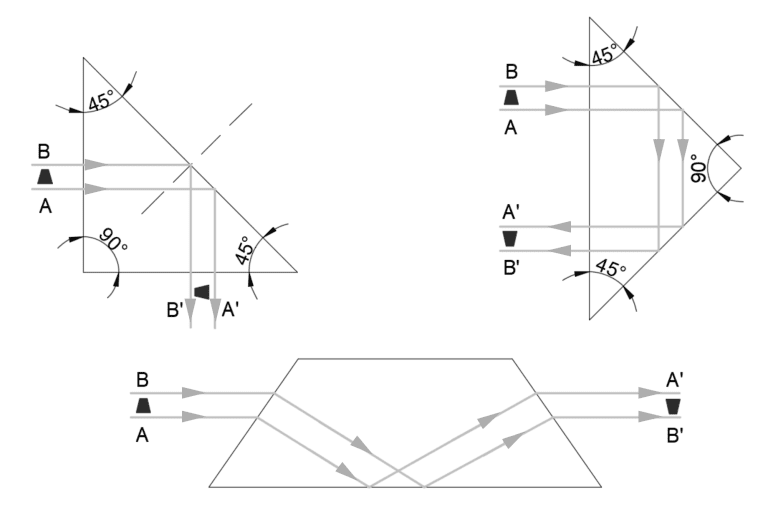
  • Image Manipulation: Right-angle and Porro prisms utilize TIR to rotate or invert images in binoculars and SLR cameras.
  • Dispersion Control: In spectroscopy, TIR interfaces are engineered to manage chromatic aberration or to achieve specific phase shifts (e.g., Fresnel rhombs).
Total Internal Reflection, TIR
Figure 2. Internal Reflection

C. TIR in Diamond Brilliance and Facet Engineering

The “fire” of a diamond is an exercise in optimizing TIR through geometry. With a high refractive index (n ≈ 2.417), diamond has a remarkably small critical angle (approx. 24.4°).
  • Optimization: Lapidaries cut facets at precise angles to ensure that light entering the crown undergoes multiple internal reflections before exiting back through the top, maximizing the return of light to the observer.

D. TIR in Fluorescence Microscopy

Total internal reflection (TIR) is used in fluorescence microscopy to generate an evanescent wave at the glass–sample interface, selectively exciting fluorophores within approximately 50–200 nm of the surface.  Engineering Note: Although the incident light is entirely reflected at the interface, an evanescent electromagnetic field is produced in the optically rarer medium (n₂). This near-field wave decays exponentially with increasing distance from the interface. The controlled generation of this evanescent field is a critical factor in the design and application of Total Internal Reflection Fluorescence (TIRF) microscopy and optical biosensors.

E. Atmospheric Refraction and Mirages

On a macro scale, TIR explains the “inferior mirage” observed over heated asphalt or deserts.
  • Mechanism: A steep temperature gradient creates a refractive index gradient (dn/dh). As light from the sky descends toward the hotter, less dense air near the ground, it undergoes continuous refraction until it hits the critical angle and reflects upward, mimicking the appearance of a reflective water surface.

E. Frustrated Total Internal Reflection (FTIR) and Interactive

Sensors While TIR is theoretically “total,” the presence of the evanescent wave in the lower-index medium (n2) allows for the “frustration” of the reflection. If a third medium with a high refractive index (such as a finger or a polymer stylus) is brought within a distance of a few wavelengths of the interface, the evanescent wave can couple into that third medium. The Physics: This coupling “leaks” energy out of the TIR interface, reducing the intensity of the reflected beam. By measuring this drop in reflected power, a system can detect proximity or contact with extreme precision. Engineering Application: This is the foundational principle for optical touchscreens and biometric fingerprint scanners. Unlike capacitive sensing, FTIR-based sensors can be used to create large-scale multi-touch surfaces that are robust against electromagnetic interference.

Conclusion for the Practitioner

In professional optical design, TIR is a tool for energy conservation and spatial light modulation. Whether you are calculating the “stay-out” zones in a lens barrel to prevent stray light or designing a frustrated total internal reflection (FTIR) touch sensor, the transition at θc represents the boundary between refractive loss and reflective efficiency. Understanding the wavelength dependence of the refractive index (dispersion) is further required to ensure that TIR conditions are met across the entire operating spectrum of your device.
Related Content

GREAT ARTICLE!

Share this article to gain insights from your connections!