

Parabolic and spherical mirrors are core elements in advanced optical systems, from laser beam conditioning to astronomical telescopes. This page explains when a concave parabolic mirror is preferred over a spherical mirror, how each impacts wavefront quality and collimation, and why design trade‑offs like cost, footprint, and alignment drive real‑world choices.
Early internal link: see our dedicated Off‑Axis Parabolic Mirrors page for detailed capabilities and specifications.
Key Takeaways
- The main difference between a parabolic mirror and a spherical mirror is aberration: parabolic mirrors focus or collimate light without spherical aberration on‑axis, while spherical mirrors introduce residual aberrations at fast focal ratios.
- Spherical mirrors (concave and convex) are simpler and more economical, but a concave parabolic mirror is preferred when diffraction‑limited focusing or precise collimation is required, such as in high‑brightness sources and laser systems.
- Parabolic mirrors are typically larger and more complex to fabricate; choosing between parabolic mirror and spherical mirror requires balancing beam diameter, field of view, cost, and package constraints.
- Avantier offers custom off‑axis parabolic mirrors and spherical mirrors, including coatings and tolerances tailored to telescope, metrology, and high‑power laser applications.
What Is a Parabolic Mirror?
A parabolic mirror is a reflective surface whose cross‑section follows a parabola; in optical terms, a concave parabolic mirror converts a point source at its focus into a collimated beam, or focuses a collimated beam to a diffraction‑limited spot. Because all paraxial rays from infinity reflect to the same focal point, a parabolic mirror eliminates on‑axis spherical aberration that plagues fast spherical mirrors.
In practical systems, most parabolic mirrors used are concave; when designers ask “is a parabolic mirror concave or convex?”, they almost always mean the concave parabolic form used in telescopes, laser delivery lines, and beam expanders. Convex parabolic segments are less common and usually appear in specialized relay or scanning geometries.
Internal link to reflective products: explore how parabolic and spherical mirrors fit into our broader Optical Mirrors portfolio.
Spherical Mirrors: Concave and Convex
Spherical mirrors approximate a section of a sphere and come in concave and convex types. A concave spherical mirror has a reflective surface that curves inward and a positive focal length; a convex spherical mirror curves outward and has a negative focal length.
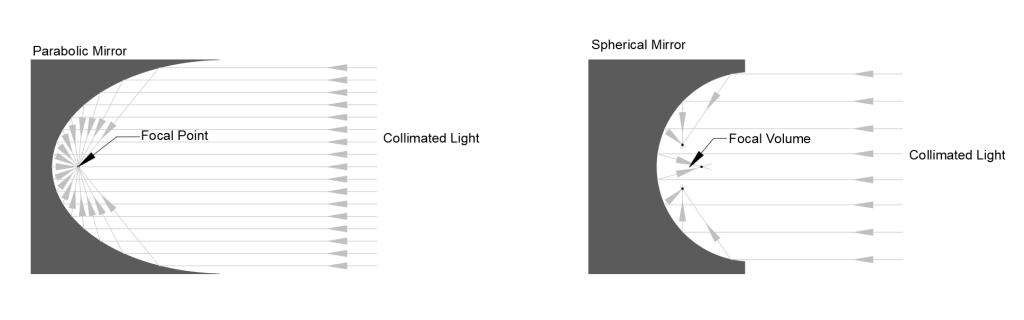
Compared with a concave parabolic mirror, a concave spherical mirror:
- Is easier and less expensive to manufacture.
- Introduces spherical aberration when used at low f‑numbers or over wide fields.
- Can still perform well when the beam diameter is small or the system is relatively slow (higher f‑number).
For fundamentals and terminology on concave and convex spherical mirrors, see our Spherical Mirrors and “Comprehensive Guide to Spherical Mirrors”.
Why Is a Parabolic Mirror Used in Reflecting Telescopes?
In a reflecting telescope, the primary goal is to collect as much light as possible and focus it to a small spot with minimal aberration. A concave parabolic mirror for telescope applications is ideal because it:
- Brings parallel rays from astronomical sources to a common focus without on‑axis spherical aberration.
- Supports large apertures and fast focal ratios (low f‑number) while maintaining near diffraction‑limited performance on‑axis.
- Avoids chromatic aberration entirely, since focusing is achieved by reflection rather than refraction.
Spherical primaries can be used in certain telescope designs (for example, Schmidt or corrector‑based systems), but they require additional optics to correct spherical aberration. For many high‑performance reflecting telescopes, a concave parabolic mirror remains the simplest path to high image quality.
Internal link to OAP mirrors in astronomy and metrology: see engineering‑focused examples in our article on Large Aperture OAP Mirrors: Precision in Optics.
Design Trade‑Offs: Parabolic vs Spherical Mirrors
Beam diameter and performance
For small beam diameters or slow systems, the difference between a concave spherical mirror and a concave parabolic mirror becomes less pronounced; residual spherical aberration may fall within the system’s wavefront error budget. As the beam diameter grows or the system is pushed to faster f‑numbers, parabolic mirrors increasingly outperform spherical mirrors for:
- Collimating light from point sources (LEDs, fiber outputs, lamp houses).
- Focusing collimated beams to tight, near diffraction‑limited spots (laser focusing, microscopy).
Cost, size, and manufacturability
Parabolic mirrors—especially off‑axis segments—are more complex to fabricate and test. They typically:
- Require advanced machining and metrology, raising unit cost.
- Occupy more space than a simple spherical mirror of similar clear aperture.
- Demand tighter alignment control to realize their full aberration advantage.
Spherical mirrors, by contrast, are mechanically simple, scalable, and often sufficient where performance requirements are moderate or where corrective optics can be added cost‑effectively.
Off‑Axis Parabolic Mirrors: Practical Parabolic Implementations
In many instruments, the focus of a full parabolic mirror is mechanically difficult to access. Off‑axis parabolic (OAP) mirrors solve this by using an off‑center section of a parent paraboloid, displacing the optical axis and freeing up space around the focal region.
Avantier’s Off‑Axis Parabolic Mirrors offer:
- Precision collimation of point sources and focusing of collimated beams with minimal wavefront distortion.
- Compact, obstruction‑free geometries that simplify packaging in congested systems.
- Customizable materials, surface figures (down to 1/10 λ RMS), and reflective coatings (protected Al, Ag, Au, or dielectric).
For stock and custom configurations, visit our Off‑Axis Parabolic (OAP) Mirrors page.
When to Choose a Concave Parabolic Mirror vs a Spherical Mirror
In practice, designers weigh the following when deciding between parabolic and spherical mirrors:
- Required wavefront quality: If the system must approach the diffraction limit on‑axis with a fast beam, a concave parabolic mirror or OAP is usually preferred.
- Beam diameter and NA: Larger beam diameters and higher NA magnify spherical aberration in spherical mirrors, pushing designs toward parabolics.
- Field of view: For narrow‑field applications, parabolics shine; for wide fields, additional aspheric or corrective optics may be needed regardless of mirror type.
- Budget and complexity: Spherical mirrors are more cost‑effective and are often chosen when design budgets allow for some aberration or when corrective lenses are acceptable.
Avantier supports both approaches and can help you decide whether a parabolic mirror or spherical mirror architecture better fits your optical, mechanical, and commercial constraints.
FAQs
What is a parabolic mirror, in practical design terms?
A parabolic mirror is a concave reflective surface whose profile follows a parabola, allowing it to convert a point source at the focus into a collimated beam or to focus collimated light to a near diffraction‑limited spot. It is widely used in telescopes, laser focusing, and illumination systems where spherical aberration from spherical mirrors is unacceptable.
Is a parabolic mirror concave or convex?
In nearly all optical design contexts, “parabolic mirror” refers to a concave parabolic mirror, which has its reflective surface on the inside of the paraboloid and a positive focal length. Convex parabolic segments exist but are much less common and are used in specialized relay and scanning configurations.
Why is a parabolic mirror used in reflecting telescopes?
A concave parabolic mirror is used in reflecting telescopes because it focuses parallel light from distant astronomical objects to a single focal point without introducing on‑axis spherical aberration, enabling high image quality at large apertures and fast focal ratios. This makes it superior to a simple spherical mirror for many high‑performance telescope designs.
Choosing the right mirror starts with the optical requirement, not the component name.
If you are designing for high wavefront quality, tight collimation, or compact optical packaging, our engineering team can help specify a custom off-axis parabolic mirror for your system. Visit the solution page or reach out with your requirements for a technical consultation.




GREAT ARTICLE!
Share this article to gain insights from your connections!