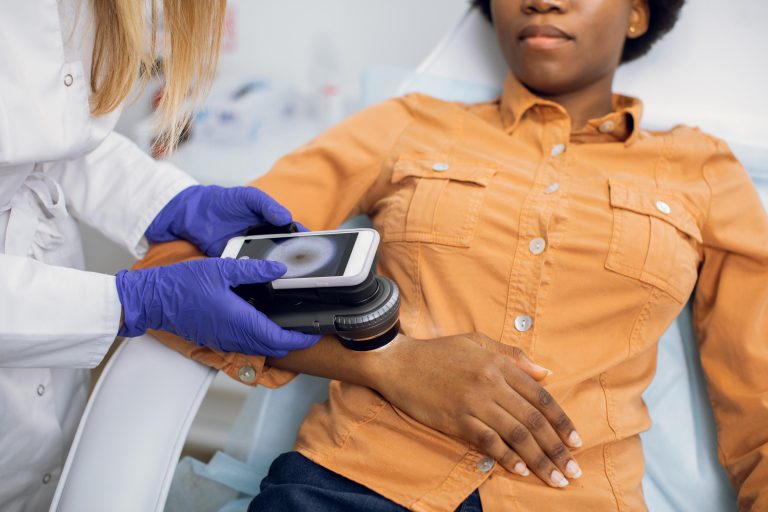
Optical coherence tomography (OCT) enables non-invasive imaging for swift skin cancer diagnosis without biopsies.
AI-driven biophotonic analysis automates biological disease detection from inner ear infections to surgical tissue assessments.
Biophotonics merges optical technologies with AI, advancing medical interventions and research precision.
Advancing Medical Diagnostics with Biophotonic Sensing
Biophotonic sensors and systems are optical devices that can provide point-of-care diagnostics for medical practitioners and health researchers. They enable researchers to detect, sense, identify, and understand biological systems at the cellular/sub-cellular level, giving them a new understanding of biological processes, conditions, and molecular changes.
Biophotonics is a rapidly growing field, and optical designers and researchers are constantly developing new ways of achieving high-quality imaging, more sensitive detection, and more comprehensive analysis. Medical advances powered by photonics technologies include breakthroughs in disease diagnosis, food & water safety, and drug efficacy testing. Some involve Here we’ll look at a few biophotonic advances and how they’re already making a difference to medical diagnostics and research.
Lab-on-a-chip Point-of-Care Biophotonic Sensors
Early and efficient diagnosis of disease is being made possible by low cost point-of-care biosensors that can provide lab results within minutes -eliminating the need for extensive lab equipment, long wait times, and large laboratories.
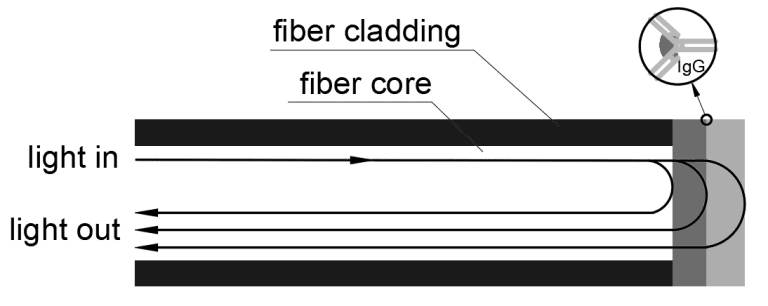
One example of this is the lab-on-a-chip biosensors designed in response to the worldwide COVID pandemic. Inefficient testing protocols were partly responsible for the early spread of the disease, and health researchers across the world worked hard to find a quick, reliable way to determine the presence of the virus. One of these ways turned out to be a SARS-CoV-2 specific immunoglobulin G biophotonic sensor which used biofunctionalization to selectivity detect specific COVID antibodies. The sensors can be fabricated on the face of a single fiber optic, a single mode fiber-28, and are sensitive enough to determine whether or not a sample contains antibodies in as little as a minute.
Modern biophotonic sensors can be built to fit the literal head of a pen and detect extremely low concentrations of antibodies
Optical Coherence Tomography (OCT) in Dermatology
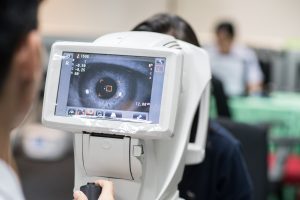
It used to be that medical practitioners needed to do a biopsy to determine the presence of malignant tissue on skin, but today optical coherence tomography enables a swifter, simpler diagnosis without any skin excision. It is able to image skin to a depth of 2 mm, and resolution can be between 15 and 3 μm.
Biophotonics can also be used during surgery to ensure complete removal of problematic tissue. The skin is treated with nanoparticles that have been functionalized with fluorescent dyes and chosen to congregate in a particular kind of tissue. When the skin is exposed to appropriate wavelengths of dye, the malignant tissue will glow, enabling the surgeon to use epifluorescent microscopy and optical detection to determine what needs to be cut and what can be left.
AI and Biophotonic Analysis
Deep learning is not only essential for natural language processing and humanoid chatbots, it’s key for the processing of biophotonic data as well. Just as machines can learn to understand human language, they can learn to read the fingerprints of cells, organelles, and molecules. Basic diagnostics can be automated, and verification steps can be built into the system to ensure that nothing goes wrong. Label-free identification of biological compounds sometimes requires analysis of complex spectrum, and this can be accomplished by feed-forward neural networks (multilayer perceptrons, MLP) or recurrent neural networks (RNNs). These neural networks can perform comparisons of test spectrum with extensive cataloged records to determine the likelihood of abnormal growths, disease, or the presence of various molecules. Deep learning algorithms can also perform matrix multiplication that involves millions of parameters, solving complex equations that allow denoising, semantic segmentation, disease recognition and even pseudostaining. Advances in AI are increasing the speed of processing and the potential of these analytical methods day by day. Examples of machine learning and biophotonics include AI solutions that drawn on extensive libraries of imaging data to automatically detect the signs of infection in the inner ear. An OCT image of the ear can be taken by a portable device, and within half a minute the AI-powered software can evaluate the data and diagnose it as skillfully as an expert. Another example of AI in action is an intraoperative diagnosis system using stain-free, slide-free multimodal multi photon microscopy. The data rich images extracted by this biophotonic technology would take extensive time to analyze manually, but an AI system can produce a reliable, verifiable diagnosis in no more than a few minutes. Avantier is proud to be part of pushing back the boundaries of science with advances in biophotonics. If you need a custom optical component we can manufacture exactly what you need, and our optical designers are available to help you determine just what configurations will work best with your system. Contact us today if you’d like to set up a consultation or request a quote.