
Collimating Lenses for Precision Parallel Beam Control
High-Performance Collimating Lenses for Laser, Imaging, and Sensing Systems
Collimating lenses convert divergent light into highly parallel beams, ensuring maximum accuracy, repeatability, and signal integrity in optical systems. Furthermore, Avantier designs and manufactures custom collimating lenses optimized for industrial, scientific, medical, and photonics applications.
Our solutions deliver superior beam parallelism, low wavefront error, precise focal control, and high-transmission coatings, supported by advanced optical metrology and in-house fabrication.
Factory Standard
| Focal Length (EFL) | 2 mm – 150 mm (custom to 500 mm+) |
| Numerical Aperture (NA) | 0.02 – 0.6 |
| Clear Aperture | 3 mm – 50 mm (custom available) |
| Collimated Beam Diameter | 0.5 mm – 30 mm |
| Beam Divergence | < 0.1 mrad typical |
| Wavefront Error | < λ/4 to < λ/10 |
| Focusing Accuracy | ±1% – ±0.1% |
| Transmission | > 99% with AR coating |
Engineering Advantages of Choosing Avantier for Collimating Lenses
Avantier offers comprehensive engineering capabilities to support the design, fabrication, and testing of custom collimating lenses.
Custom Optical Engineering
Specifically, Avantier supports custom optical designs using advanced materials and configurations, including:
- UV–IR materials (Fused Silica, CaF₂, BK7, specialty glass)
- Aspheric, achromatic, and reflective designs
- Precision optomechanical housings and fiber ferrules
In-House Fabrication & Coating
Avantier provides advanced fabrication and coating capabilities to meet demanding optical requirements. Additionally, these capabilities include:
- CNC optical processing
- Ion-beam polishing & AR coating
- High-damage-threshold coatings available
Metrology & Quality Control
Furthermore, Avantier verifies optical performance and reliability through comprehensive testing methods, including:
- Interferometry
- MTF and surface quality testing
- Full traceable inspection data
Collaborative Engineering Support
In addition, customers receive support throughout the design process, including:
- Focal length selection
- Divergence and beam waist targets
- Coating and wavelength optimization
- Mechanical mounting requirements
Ideal for OEM integration, R&D prototyping, and high-volume production.
Technical Resources
What Are Collimating Lenses?
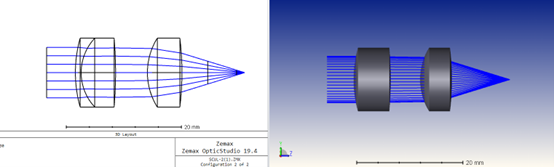
A collimating lens is a curved optical element engineered to turn spreading light into a parallel beam. This control of beam divergence is essential in:- Laser beam shaping
- Spectroscopy and interferometry
- Optical measurement instrumentation
- Fiber-optic communication and sensing
- Radiography and inspection systems
Types of Collimating Lenses
By Optical Principle
| Type | Features | Typical Use |
| Transmissive collimating lenses | Refractive control (plano-convex, achromatic, aspheric) | Laser optics, imaging, sensing |
| Reflective collimators | Off-axis parabolic mirror for achromatic performance | Broadband sources, high-power lasers, IR/UV |
By Optical Design
| Design | Benefit | Application |
| Plano-convex / biconvex lenses | Cost-effective, simple collimation | General system collimation |
| Achromatic doublets | Correct chromatic & spherical aberrations | Broadband spectroscopy, imaging |
| Aspheric lenses | Minimized aberrations, improved collimation | High-precision laser & metrology |
| Cemented doublets / custom assemblies | Diffraction-limited accuracy | Scientific instruments |
By Configuration
| Type | Benefit |
| Fixed collimators | Factory-calibrated for production stability |
| Adjustable collimators | Tunable for variable divergence or R&D |
| Fiber collimators (FC/APC, FC/PC, SMA) | Efficient fiber-to-free-space coupling |
Key Performance Parameters
When selecting a collimating lens, engineers should evaluate:
- Focal length & numerical aperture (NA)
- Beam divergence & spot quality
- Wavefront error / angular precision
- Material properties & refractive index
- AR coating performance at target wavelengths
- Environmental stability & housing precision
Additionally, Avantier provides full interferometry and surface metrology to verify each specification.
Applications of Collimating Lenses
Collimating lenses support high-performance optical systems across industries. For example, they are used in industrial, medical, scientific, and aerospace systems.
Industrial & Scientific
- Laser cutting, welding, and precision alignment
- Optical metrology, beam expansion, particle sizing
- Spectroscopy and spectrophotometry
- Display measurement & calibration
Medical & Security
- Radiography beam shaping (X-ray, neutron, gamma)
- Scintillation imaging & nuclear detection
- Radiotherapy collimation and field control
Fiber Optics & Photonics
- Telecom fiber-to-free-space coupling
- Photodiode and photodetector integration
Research & Aerospace
- Astronomy and remote sensing
- Interferometry and optical testing platforms
Work With Avantier — Your Collimating Lens Partner
Whether you need a compact fiber collimator, a diffraction-limited lens system, or custom OAP mirror collimator, Avantier delivers precision optical solutions designed to outperform standard catalog components.
Request a quote or schedule a design consultation
FAQ
What are collimating lenses used for?
Collimating lenses convert divergent light into a parallel beam, improving beam quality and measurement accuracy. Consequently, they are used in spectroscopy, laser systems, fiber-optic communication, medical imaging, and optical metrology.
How do I choose the right collimating lens?
Key considerations include focal length, numerical aperture, beam divergence, wavefront error, coating type, and intended wavelength. Additionally, material selection and mechanical mounting requirements should match the system’s precision and environmental needs.
Do collimating lenses reduce light intensity?
Yes. While collimating lenses improve beam uniformity and spatial resolution, they typically lower light intensity. Proper optical design minimizes loss and maximizes system performance.
Can collimating lenses be customized?
Absolutely. Custom collimating lenses are available with specific focal lengths, optical materials, coatings, fiber interfaces, and mechanical housings. They can be optimized for UV, visible, IR, or broadband use.
What industries use collimating lenses?
Collimating lenses are used across many industries. Specifically, these industries include semiconductor manufacturing, medical imaging, aerospace, telecommunications, spectroscopy labs, laser processing, and nuclear detection systems.
Related Content
WE CAN HELP YOU!
Contact us NOW for sales & expert advice.