

Microscope Objective Lenses
Avantier is a premier manufacturer of high-performance microscope objective lenses, producing objectives for research, industry, forensics, and medical diagnostics applications. Objectives are available in apochromatic, achromatic, and semi-apochromatic designs, with custom objectives engineered to perform within specific spectral ranges for applications requiring precise imaging beyond standard configurations.
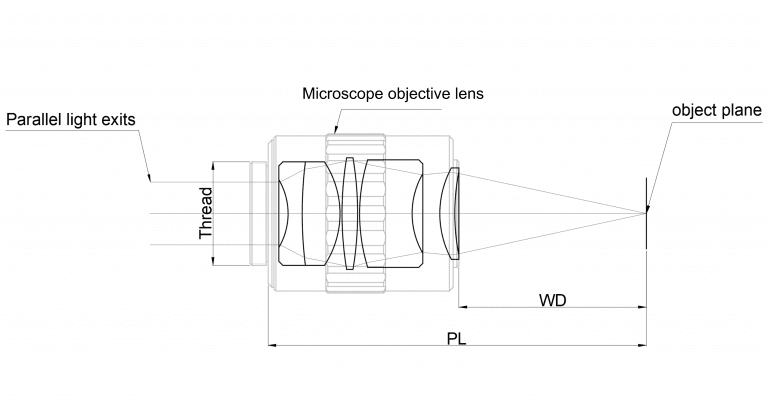
A microscope objective lens forms a real, magnified image of an object within its field of view, which is then further magnified by
the ocular lens (eyepiece) for observation. As the first optical element in the imaging path, the objective sets the resolution and clarity
of the final image.
Looking for a ready-to-integrate microscope objective? Browse the Microscope Objective Lenses stock page for stock apochromatic, achromatic, and semi-apochromatic options — Please contact us if you are exploring custom objective solutions for applications requiring specialized spectral performance.
Significance of the Microscope Objective Lenses
The objective lens is a microscope’s most critical component, largely determining resolving power, magnification, and image quality.
Objectives are designed to magnify an object by a specific factor, ranging from 4x (scanning objective) to 40x (high-power objective), and even up to 100x for oil immersion lenses. To maximize flexibility, microscopes are often equipped with up to four objectives mounted on a rotating nosepiece or turret. In the case of an infinity-corrected objective lens, magnification is calculated by dividing the reference focal length by the objective’s focal length.
The microscope’s total magnification can be calculated by multiplying the magnification power of the eyepiece by that of the objective lens. For example, viewing an object through a 10x eyepiece and a 4x objective results in a 40x magnified image.
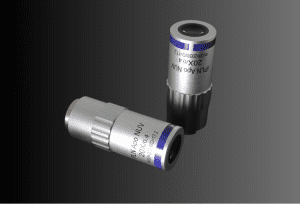
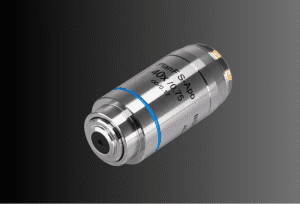
Types of Objective Lenses
Objective lenses are designed to correct various optical imperfections and optimize the image quality for different applications. These lenses differ in terms of aberration correction, system type, and immersion medium, making them suitable for various microscope setups.
A. Aberration Correction
- Achromatic Objective Lenses
These are the most cost-effective lenses, designed to correct chromatic aberration (color distortion) in two wavelengths (blue and red) and spherical aberration (blurring) in one (green). Achromatic lenses are ideal for general microscopy and provide better image quality when used with a green interference filter. - Plan Achromatic Objective Lenses
A step up from achromatic lenses, plan achromatic objective lenses correct for flat-field aberration, ensuring a more uniform focus across the entire field of view. These lenses are great for applications requiring clearer and more precise imaging. - Semi-Apochromat Lenses
Semi-apochromats offer higher quality than plan achromats by correcting additional spherical aberrations, improving numerical aperture (NA). This allows for better resolution, making them ideal for more demanding microscopy applications. - Apochromatic Lenses
The highest-performing lenses, apochromats correct for a wide range of aberrations and have the highest numerical aperture (NA), resulting in exceptional resolution. These are commonly used in research applications requiring precise color photomicrography.
B. System Type
- Reflective Objective Lenses
These lenses use mirrors instead of traditional lens elements. The key benefits include zero chromatic aberration and long working distances. Reflective lenses are particularly useful for FTIR spectroscopy or high-precision imaging where aberration-free results are critical. - Refractive Objective Lenses
Traditional lenses made from transparent materials like glass. These lenses use refraction to focus light, correcting for optical aberrations and providing clear, sharp images. Refractive lenses are versatile and suitable for most standard microscopy needs.
C. Immersion Medium
The choice of immersion medium between the objective lens and the specimen can dramatically affect the resolution and performance of the lens. Different media are used to improve light collection and enhance clarity.
- Oil Immersion Objective Lenses
These lenses use special oil with a specific refractive index to achieve the highest numerical aperture (NA), resulting in superior resolution and sharpness. They are commonly used in biological and high-precision research microscopy. - Water Immersion Objective Lenses
Using water as the medium, these lenses provide an alternative to oil immersion, offering higher resolution than air lenses. Water immersion is commonly used in biological microscopy for observing living specimens. - Air Immersion Objective Lenses
The most common type, these lenses use air between the lens and specimen. While they offer good resolution, they are generally not as powerful as immersion lenses in terms of numerical aperture and resolution. - Glycerol Immersion Objective Lenses
Glycerol is used as the immersion medium for its high refractive index, offering a good balance between oil and water immersion. Glycerol lenses are used in specialized microscopy techniques where improved light collection is required.
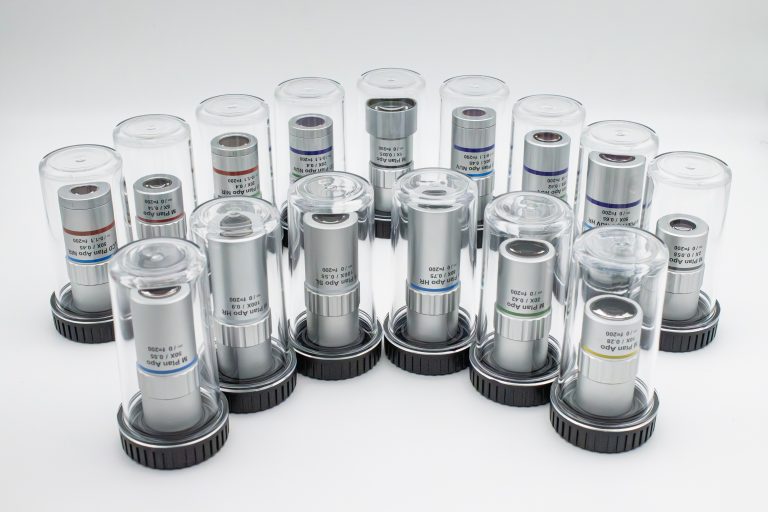
Microscopes and Their Compatible Objective Lenses
Different microscopes are designed for specific tasks, and selecting the right objective lens is crucial for optimal performance. Here’s a breakdown of common types of microscopes and the corresponding objective lenses that provide the best results for each application.
A. Compound Microscopes
- Application: Ideal for examining thin, transparent specimens such as cells, tissues, or microorganisms.
- Compatible Objective Lenses:
- Achromatic (for general viewing)
- Plan Achromat (for more precise imaging with flat-field correction)
- Oil Immersion (for detailed examination of fine cellular structures)
B. Metallurgical Microscopes
- Application: Specialized for observing opaque materials like metals, minerals, and alloys, often in industrial or materials science applications.
- Compatible Objective Lenses:
- Plan Achromat or Semi-Apochromat lenses for clearer, high-resolution images of metal surfaces.
- Reflective Objective Lenses for observing opaque specimens with zero chromatic aberration.
C. Stereo Microscopes
- Application: Used for 3D viewing of objects at low magnifications (2x-50x). Common in applications like assembly, quality control, and dissection.
- Compatible Objective Lenses:
- Low magnification (2x-50x) refractive lenses for clear, distortion-free images.
D. Digital Microscopes
- Application: Microscopes optimized for digital imaging and capturing high-quality images for processing and analysis.
- Compatible Objective Lenses:
- Refractive Objective Lenses (for sharp, detailed digital images)
- Fluor Objective Lenses (for fluorescence microscopy, if applicable).
E. Darkfield Microscopes
- Application: Best for observing living organisms or unstained specimens with high contrast against a dark background.
- Compatible Objective Lenses:
- Oil Immersion or Water Immersion Lenses for high contrast and clarity in unstained specimens.
Popular Objective Lenses for High-Magnification Observations
Some specific lenses are highly recommended for high-magnification applications across various types of microscopes:
- 40x Microscope Objective Lenses
Often used for examining cellular structures and small organisms in biological research. - 100x Microscope Objective Lenses
Oil immersion lenses used for the highest magnification, ideal for fine cellular details, and observing bacteria or organelles in biological samples. - Fluor Objective Lenses
Used in fluorescence microscopy for color-sensitive imaging of specimens that have been stained with fluorescent dyes.
Custom Microscope Objectives
Avantier continues to redefine precision microscopy with its cutting-edge NIR, NUV, and UV infinity corrected objectives. Engineered for accuracy and clarity, these objectives elevate research and analysis across near-infrared (NIR), near-ultraviolet (NUV), and ultraviolet (UV) spectra. Advanced optical coatings, aberration correction, and infinity-corrected designs let researchers explore samples with unmatched clarity and fidelity. These objectives are pivotal for applications ranging from materials science to life sciences, enabling scientists to delve deeper into the microscopic world with confidence. Avantier offers a wide variety of microscopes, each equipped with multiple objective lenses that can be rotated to view specimens at varying magnification powers. If you want a comprehensive resource on how to choose the right microscope lens for your application, explore The Complete Guide to Microscope Objective Lens. Demonstrating its commitment to excellence, Avantier delivers tools that empower scientific discovery and innovation.
If you’re interested in acquiring in-stock microscope objective lenses, please visit our ‘Stock – Microscope Objective‘ page. For custom solutions, don’t hesitate to contact us.




WE CAN HELP YOU!
Contact us NOW for sales & expert advice.